


Introduction
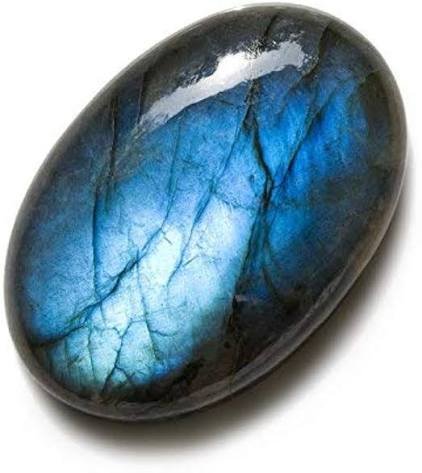
Some gemstones capture attention through their brilliance, while others stand out because of their changing colours. Labradorite belongs to the second category. With a grey, charcoal, or dark base and flashes of blue, turquoise, green, gold, yellow, and orange, this distinctive feldspar gemstone offers a striking combination of natural character and visual depth.
The beauty of a Labradorite gemstone often becomes most noticeable when it is tilted under light. A stone that initially looks relatively understated may suddenly reveal vivid bands or patches of colour. This optical effect makes Labradorite popular among gemstone collectors, jewellery designers, lapidary artists, and crystal enthusiasts.
Polished Labradorite cabochons are especially attractive for pendants, statement rings, earrings, and custom jewellery. Their individual colour patterns also make them appealing to buyers seeking distinctive stones for personal collections or creative projects.
Whether you are exploring a Natural Labradorite stone for the first time or sourcing Labradorite wholesale for jewellery production, understanding its mineral properties, appearance, quality factors, and care requirements will help you make an informed decision.
What Is Labradorite?
Labradorite is a feldspar mineral belonging to the plagioclase series, a group of rock-forming minerals containing varying proportions of sodium and calcium. Its approximate chemical formula is (Ca,Na)(Al,Si)₄O₈.
The mineral was named after Labrador, in Newfoundland and Labrador, Canada, where it was documented historically. Its characteristic colour flashes, known as labradorescence, helped establish its reputation as a decorative and collectible gemstone.
Geological formation
Labradorite occurs in several types of igneous rocks, particularly anorthosite and related rocks. It forms as magma cools and minerals crystallise. During its geological development, microscopic intergrowths of feldspar with differing compositions can develop within the crystal.
These extremely fine internal structures interact with light, producing the optical effect associated with Labradorite.
Where is Labradorite found?
Notable occurrences and commercial sources include:
- Canada: Labrador and other areas of Newfoundland and Labrador.
- Finland: Known for distinctive material marketed as Spectrolite.
- Madagascar: A recognised source of decorative and gem-quality Labradorite.
- Other localities: Labradorite also occurs in geological settings in countries including Norway, Russia, and the United States.
A stone’s appearance alone cannot establish its geographical origin. Buyers requiring origin information should request appropriate supplier documentation or independent verification.
Labradorite Appearance and the Science of Labradorescence
The defining feature of Labradorite is labradorescence, an optical phenomenon that produces broad, shimmering flashes of colour across parts of the stone.
Rather than being ordinary surface paint or a simple coating, the effect arises from light interacting with extremely thin internal layers or intergrowths within the feldspar. Light waves reflected from these structures interfere with one another, causing particular colours to become visible.
The resulting display can include:
- Blue and electric-blue flashes
- Turquoise and blue-green highlights
- Green and emerald-like tones
- Golden yellow and warm amber colours
- Orange and, in some specimens, violet hues
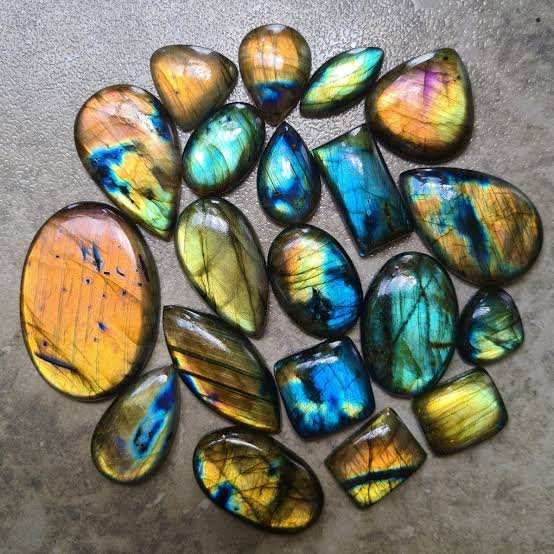
The colour display varies from one specimen to another. Some stones reveal one dominant blue flash, while others show several colours in different areas.
Why does Labradorite change colour?
Labradorite does not necessarily change its physical colour when moved. Instead, the visible optical effect changes with the direction of illumination and the viewing angle.
A stone may appear grey when viewed straight on but reveal a vivid turquoise flash when tilted. The size, orientation, and internal structure of its colour-producing layers influence the result.
This is why cutting orientation matters. A well-oriented Labradorite cabochon can display its strongest colour when viewed from the front, making it more suitable for jewellery and display.
Labradorite Gemstone Properties
The following table summarises the principal mineralogical characteristics of Labradorite. Values are typical ranges rather than guaranteed specifications for every specimen.
| Property | Description |
|---|---|
| Mineral name | Labradorite |
| Mineral group | Feldspar; plagioclase series |
| Chemical composition | General formula: (Ca,Na)(Al,Si)₄O₈ |
| Mohs hardness | Approximately 6–6.5 |
| Crystal system | Triclinic |
| Cleavage | Good to perfect in two directions; cleavage is an important durability consideration |
| Lustre | Vitreous to subvitreous |
| Transparency | Transparent to translucent; many decorative specimens appear opaque in their body colour |
| Typical colours | Grey, dark grey, blue, green, yellow, gold, orange, and multicoloured flashes |
| Specific gravity | Approximately 2.68–2.72 |
| Common market forms | Rough specimens, slabs, cabochons, beads, carvings, polished stones, and decorative objects |
These properties are consistent with mineralogical references such as Mindat’s Labradorite entry and gemmological literature on feldspar optical effects.
Labradorite Types and Colour Variations
Labradorite is available in a wide range of visual styles. Colour descriptions generally refer to the dominant visible flash rather than separate mineral species.
Blue-flash Labradorite
Blue-flash Labradorite is popular for its vivid blue highlights against a grey or dark background. Depending on the stone’s orientation, the colour may appear as a narrow streak, a broad patch, or a dramatic surface-wide flash.
Green-flash Labradorite
Green-flash Labradorite displays green or blue-green colour effects. It can be an appealing choice for pendants, statement jewellery, and decorative gemstone collections.
Golden and yellow-flash Labradorite
Golden and yellow flashes create a warmer appearance. Some specimens also display orange or amber tones, providing contrast against a darker body colour.
Multicolour Labradorite
Multicolour Labradorite can show combinations of blue, turquoise, green, gold, yellow, orange, and occasionally violet. These stones are particularly attractive for custom jewellery because each colour pattern is different.
Spectrolite
Spectrolite is a name strongly associated with distinctive Labradorite from Finland, particularly material known for its vivid, broad, and varied spectral colours. It is not a separate mineral species.
The term should not be applied automatically to every multicoloured Labradorite. Without reliable origin information, a visually colourful specimen is better described as multicolour Labradorite.
Labradorite Uses
Labradorite is valued for its optical character, decorative appeal, and versatility in lapidary work.
1. Jewellery making
Labradorite is used in pendants, earrings, brooches, bracelets, and statement rings. Its flashes can create a striking focal point in both contemporary and traditional designs.
2. Labradorite cabochons
A cabochon is a gemstone cut and polished with a smooth, rounded or domed surface rather than multiple facets. This form is particularly useful for Labradorite because a broad polished surface can reveal its colour flashes.
Cabochons are commonly incorporated into bezel settings, wire-wrapped jewellery, and handcrafted designs.
3. Beads and accessories
Polished beads and small decorative pieces are used in necklaces, bracelets, and other accessories. Colour consistency may be important when matching multiple stones for a coordinated design.
4. Lapidary work and collecting
Lapidary artists work with rough material, slabs, and preforms to produce custom cabochons and carvings. Mineral collectors may also favour specimens that demonstrate particularly interesting optical effects.
5. Ornamental objects
Larger pieces may be used for polished displays, carvings, and decorative objects, where the natural colour pattern becomes the main visual feature.
Is Labradorite suitable for jewellery?
Labradorite has a Mohs hardness of approximately 6–6.5, but hardness is not the same as toughness. Its pronounced cleavage means it can split or chip if struck in an unfavourable direction.
Pendants and earrings are generally less exposed to impacts than rings. For rings and other frequently worn pieces, protective settings, careful handling, and an appropriate design are advisable.
Labradorite Benefits and Spiritual Associations
In crystal-belief communities, Labradorite is traditionally associated with creativity, intuition, transformation, self-reflection, and protection. Some people use it as a meditation object, a personal symbol of change, or a decorative reminder of their intentions.
These meanings belong to spiritual and cultural traditions rather than established mineral science.
There is no reliable scientific evidence that Labradorite independently provides supernatural protection, guarantees success, or cures or treats medical conditions. It should not replace professional medical care.
For collectors and jewellery enthusiasts, its well-established appeal lies in its mineral structure, optical effect, and distinctive appearance.
How to Identify Genuine Labradorite
Recognising Labradorite requires more than looking for colourful flashes. Although labradorescence is a useful clue, colour effects alone cannot confirm mineral identity or prove that a stone is untreated and natural.
Consider the following checks:
- Examine the colour flash. Tilt the stone under a light source and look for broad or patch-like colour effects that appear at particular angles.
- Inspect the body colour. Many specimens have a grey or dark background, although the appearance varies.
- Check the surface. Look for chips, scratches, pits, polish marks, and visible inclusions that may affect appearance or durability.
- View the stone from several angles. Observe how much colour is visible face-up and how the flash changes when the stone is tilted.
- Review the seller’s description. Ask whether the material is represented as natural, whether any treatments are known, and whether origin claims are documented.
- Seek professional testing when needed. A qualified gemmologist or gemmological laboratory can use appropriate testing to assess identity and, where possible, treatments.
Photographs and online descriptions cannot conclusively establish authenticity, treatment status, or geographical origin. Independent examination is advisable when these details are commercially important.
Labradorite Quality Factors: What Should Buyers Check?
The best Labradorite is not necessarily the largest or most colourful specimen. Quality depends on the intended use and the buyer’s preferences.
Colour intensity and visibility
Look for flashes that are easy to see under ordinary viewing conditions. Strong colour may be desirable, but the pattern and the amount of visible colour also matter.
Colour distribution and viewing angle
A cabochon with an attractive, well-positioned flash may be more useful for jewellery than a stone whose strongest colour appears only at an awkward angle.
Cut, shape, and polish
Examine symmetry, proportions, surface smoothness, and the placement of the flash. A good polish improves presentation, but it does not by itself prove superior mineral quality.
Size, thickness, and weight
Match dimensions to the intended setting or craft project. Thickness affects how a cabochon fits into a setting and may influence the overall design.
Cracks, chips, and inclusions
Check the edges, back, and face of the stone. Visible features are not necessarily defects in a collector specimen, but cracks and chips can compromise jewellery suitability.
Application and consistency
Jewellery manufacturers may prioritise matching dimensions and colour patterns across a batch. Collectors may prefer an unusual individual specimen, while lapidary artists may focus on usable material and cutting potential.
Labradorite Price Guide: What Affects Value?
Labradorite price varies according to the characteristics of the individual stone, its intended use, and the terms of sale. There is no single price that applies to all Labradorite gemstones.
Important pricing factors include:
- Colour quality: Strength, visibility, and appeal of the labradorescence.
- Colour coverage: The amount and distribution of visible flash across the face.
- Size and weight: Larger pieces may cost more, depending on quality and demand.
- Cutting and finish: Shape, polish, thickness, and usable area.
- Condition: Chips, cracks, and other damage can affect suitability and value.
- Origin and documentation: Verified provenance may influence market positioning.
- Quantity and consistency: Wholesale pricing may depend on order size, grade consistency, and supplier terms.
- Seller reliability: Accurate descriptions, return policies, and product documentation contribute to buyer confidence.
For a meaningful price comparison, compare stones with similar dimensions, visual quality, finish, and documentation. Ask for current quotations in the stated currency and confirm whether the price is per piece, per carat, per gram, or per lot.
Labradorite vs Moonstone, Rainbow Moonstone, and Spectrolite
These materials can be confused because they belong to, or are associated with, the feldspar family and may show attractive optical effects.
| Material | Typical appearance | Optical effect | Key distinction |
|---|---|---|---|
| Labradorite | Often grey or dark, with blue, green, gold, or multicolour flashes | Labradorescence | Broad, angle-dependent patches or flashes of colour |
| Moonstone | Commonly translucent with a soft white or blue glow | Adularescence | A more diffuse, floating sheen |
| Rainbow Moonstone | Often pale or translucent with blue or multicoloured flashes | Commonly labradorescence in material sold under this trade name | Trade terminology can overlap with Labradorite; appearance and name alone do not establish identity |
| Spectrolite | Often dark with vivid, broad spectral colours | Strong labradorescence | Traditionally associated with distinctive Finnish Labradorite; origin should be substantiated |
The distinction between Labradorite and Moonstone is primarily mineralogical and optical, not simply a matter of colour. Trade names can vary, so request a precise description when mineral identity matters.
How to Clean and Care for Labradorite
With suitable care, Labradorite jewellery and polished stones can retain their appearance for a long time.
- Clean gently with lukewarm water, mild soap, and a soft cloth when appropriate.
- Rinse carefully and dry with a clean, soft cloth.
- Avoid harsh chemicals, abrasive cleaners, and rough scrubbing.
- Protect the stone from hard impacts, particularly along edges and corners.
- Store it separately from harder gemstones to reduce the risk of scratches.
- Avoid wearing Labradorite rings during heavy manual work, sports, or activities involving repeated impacts.
- Inspect jewellery settings periodically to ensure that the stone remains secure.
For mounted jewellery, consider the setting material and the jeweller’s cleaning recommendations before using any cleaning solution or equipment.
How to Buy Labradorite Online
Buying Labradorite online can be convenient, but the product listing should provide enough information to support a confident decision.
Use this checklist before placing an order:
- Photographs: Request clear images from multiple angles, ideally showing the stone tilted to reveal its colour flash.
- Dimensions and weight: Check the length, width, thickness, and weight where applicable.
- Colour description: Confirm whether the dominant flash is blue, green, golden, or multicoloured.
- Treatment disclosure: Ask the seller to disclose any known treatments and distinguish verified information from unknown details.
- Natural origin: Request a clear statement of what the seller means by natural Labradorite and any supporting documentation available.
- Product condition: Confirm whether chips, cracks, inclusions, or other visible features are present.
- Return policy: Read the terms for returns, exchanges, damaged deliveries, and discrepancies.
- Wholesale options: For bulk orders, request quantity-based quotations, available sizes, grade descriptions, and consistency information.
- Communication: Choose sellers willing to answer product-specific questions and provide accurate descriptions.
Remember that the actual stone may look slightly different from its photographs because of lighting, camera settings, screen calibration, and the viewing angle of its colour flash.
For professional jewellery production, request a photograph or video of the actual stone or batch rather than relying solely on representative product images.
