


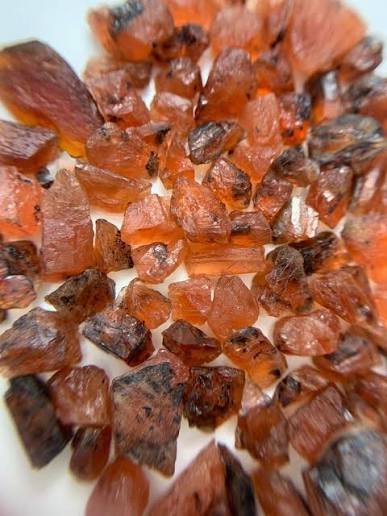
Natural minerals offer a fascinating combination of geological history, distinctive textures, and scientific interest. Among the phosphate minerals that attract attention from mineral enthusiasts, Rough Triplite stands out for its characteristic earthy colors, vitreous to resinous luster, and interesting mineralogical properties.
Triplite is a naturally occurring phosphate-fluoride mineral found primarily in certain granite pegmatites and hydrothermal tin veins. Its commonly reported colors include chestnut brown, reddish brown, salmon pink, and brownish black. These characteristics make verified Triplite specimens interesting additions to mineral collections and geological study collections.
Collectors often appreciate rough mineral specimens because they retain their natural surfaces rather than being extensively cut, polished, or reshaped. This appearance can help illustrate mineral texture, fracture patterns, and the relationship between a mineral and its geological environment.
Rough Triplite may interest mineral collectors, geology students, researchers, educational institutions, and businesses trading in natural mineral specimens.
However, accurate identification is essential. Triplite and Triphylite are different mineral species, and reddish-brown coloration alone cannot establish that a specimen is genuine Triplite.
Whether you are building a mineral collection or sourcing specimens for retail or wholesale purposes, understanding the mineral’s characteristics can help you make a more informed purchasing decision.
What Is Rough Triplite?
Triplite is a recognized mineral species belonging to the phosphate mineral class and the Triplite Group. Its ideal chemical formula is Mn₂(PO₄)F, representing manganese, phosphate, and fluorine.
Natural specimens may contain additional elements, including iron, magnesium, and calcium. Accordingly, mineralogical references also express its composition more broadly as (Mn²⁺, Fe²⁺, Mg, Ca)₂(PO₄)(F, OH).
Triplite vs. Triphylite: Understanding the Difference
The names Triplite and Triphylite are similar, but the minerals have distinct chemical compositions and crystal structures.
Triplite is primarily a manganese-rich phosphate-fluoride mineral with a monoclinic crystal system. Triphylite is a lithium-bearing iron phosphate mineral with an orthorhombic crystal system. Triphylite can also contain manganese, and its composition is commonly represented as Li(Fe²⁺, Mn²⁺)PO₄.
These differences matter when purchasing mineral specimens. A product described as Rough Triplite should not automatically be identified as Triphylite or vice versa.
If the mineral identity of a specimen has not been confirmed, its description should indicate that identification is provisional.
Natural Formation and Geological Occurrence
Triplite occurs in complex, zoned granite pegmatites and hydrothermal tin veins. In pegmatites, it may develop as part of phosphate-rich mineral assemblages during geological processes associated with the crystallization and alteration of mineral-bearing rocks. It may also replace earlier phosphate minerals.
Reported associated minerals include triphylite, lithiophilite, triploidite, wolfeite, phosphosiderite, vivianite, apatite, tourmaline, sphalerite, pyrite, and quartz. The actual mineral association varies with the geological environment.
Although Triplite has been documented at localities in several countries, the origin of an individual commercial specimen cannot be established from its appearance alone.
Appearance and Natural Characteristics of Rough Triplite
Rough mineral specimens are valued for their individual characteristics, including color, texture, shape, and visible mineral structures.
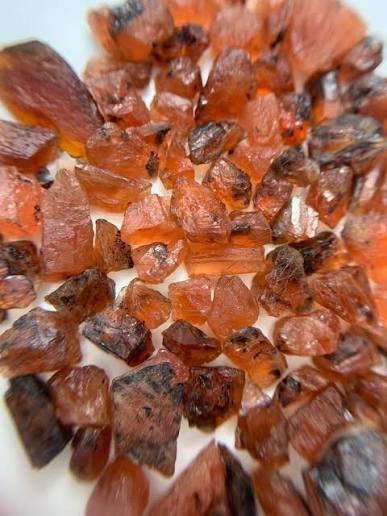
The product description supplied for this article identifies reddish-orange, brown, dark brown, and earthy shades among the specimens. These colors are compatible with the broad range of appearances reported for several phosphate minerals, including Triplite, but they do not independently confirm the mineral’s identity.
Common Visual Characteristics
Verified Triplite may display:
- Chestnut-brown or reddish-brown coloration.
- Salmon-pink or flesh-red shades in some specimens.
- Brownish-black to black surfaces where alteration has occurred.
- Vitreous to resinous luster.
- Translucent to opaque material.
- Irregular, nodular, massive, or granular forms.
These characteristics are documented in the Handbook of Mineralogy.
Individual pieces may differ in color intensity, surface condition, visible inclusions, fracture patterns, and overall shape.
Such variation is normal among natural mineral specimens. Nevertheless, similar appearances can occur in unrelated minerals, so visual characteristics should be treated as descriptive rather than conclusive evidence of identity.
Rough, Polished, and Processed Specimens
Rough Triplite: Material sold in its naturally occurring or minimally processed form. It may retain irregular surfaces and natural fractures.
Polished Triplite: Material that has undergone surface finishing to improve smoothness or reveal its appearance. Polishing does not establish authenticity.
Processed Triplite: Material that has been cut, shaped, ground, or otherwise modified for a particular purpose.
Processing should be considered carefully because Triplite has a Mohs hardness of approximately 5–5.5 and distinct cleavage. These characteristics can affect its suitability for cutting, grinding, and jewelry applications.
Physical and Mineralogical Properties
Understanding the mineral’s physical properties helps collectors and buyers distinguish scientific characteristics from marketing descriptions.
| Property | Reported characteristics of Triplite |
|---|---|
| Mineral name | Triplite |
| Mineral class | Phosphate mineral |
| Mineral group | Triplite Group |
| Ideal chemical formula | Mn₂(PO₄)F |
| Broader compositional formula | (Mn²⁺, Fe²⁺, Mg, Ca)₂(PO₄)(F, OH) |
| Common colors | Chestnut brown, reddish brown, salmon pink, brownish black, black when altered |
| Luster | Vitreous to resinous |
| Transparency | Translucent to opaque |
| Mohs hardness | 5–5.5 |
| Crystal system | Monoclinic |
| Cleavage | Good on {001}, fair on {010}, poor on {100} |
| Fracture | Uneven to subconchoidal |
| Specific gravity | Approximately 3.5–3.9 measured |
| Geological occurrence | Complex granite pegmatites and hydrothermal tin veins |
Source: Handbook of Mineralogy, Triplite mineral data.
These are reference values for the mineral species, not laboratory measurements of your inventory. Composition, alteration, and specimen condition can influence observed characteristics.
Geological Formation and Important Occurrences
Triplite is particularly associated with phosphate-bearing granite pegmatites. These geological environments can concentrate uncommon elements and produce a variety of phosphate minerals.
The mineral has also been documented in hydrothermal tin veins. Its associated minerals may include quartz, apatite, tourmaline, sulfides, and other phosphate species, depending on the deposit.
Mineralogical references document occurrences in locations including France, Germany, the Czech Republic, Portugal, Finland, Sweden, Canada, and the United States.
These localities demonstrate the mineral’s broad geological distribution. They should not be interpreted as evidence of the origin of any particular commercial specimen.
For sellers, documenting the actual source of a mineral is important. If a specimen’s mining location is unknown, describing it as natural Triplite with an unverified origin is more responsible than assigning it to a particular country or deposit.
Uses and Applications of Rough Triplite
1. Mineral Collecting
Verified Triplite specimens can be included in collections focused on phosphate minerals, manganese-bearing minerals, pegmatite minerals, and mineral-group diversity.
Collectors may consider specimen size, condition, identification, locality information, and visual characteristics when choosing individual pieces.
2. Educational and Geological Study
Triplite can support the study of mineral classification, chemical composition, crystal systems, and geological formation.
It may be useful in teaching collections and comparative studies of phosphate minerals.
3. Display Specimens
Rough specimens can be displayed in mineral cabinets, educational exhibits, or private collections. Their natural surfaces and varied shapes can make them useful examples of unpolished mineral material.
4. Wholesale and Retail Mineral Trading
Businesses may trade verified Triplite specimens for collectors, educational institutions, and specialist mineral buyers.
Clear product photographs, accurate identification, and transparent descriptions help customers understand what they are purchasing.
5. Lapidary and Jewelry Applications
Triplite has been used as a gemstone material, but its moderate hardness and distinct cleavage require careful consideration. Cutting and polishing may present challenges, and finished material may be vulnerable to damage during wear.
For this reason, rough Triplite should not automatically be marketed as suitable for everyday jewelry. Its composition and condition should be assessed before cutting or processing.
Benefits and Special Features of Rough Triplite
The principal appeal of Rough Triplite lies in its mineralogical and natural characteristics.
Natural appearance: Unpolished surfaces can preserve the specimen’s original texture and form.
Mineralogical interest: Its phosphate-fluoride composition and monoclinic crystal system make verified Triplite relevant to mineral studies.
Specimen diversity: Individual pieces can differ in shape, color, condition, and visible features.
Educational value: The mineral provides an example of how chemical composition and crystal structure help distinguish mineral species.
Collectibility: A specimen’s identification, condition, documented locality, and suitability for a collection can influence its desirability.
These are practical and educational attributes. Claims that Triplite provides medical healing, guarantees prosperity, or produces scientifically established spiritual effects are not supported by mineralogical evidence.
Rough Triplite Quality Guide: What Buyers Should Check
Before purchasing Rough Triplite, consider the following factors.
Mineral Identification
Confirm whether the specimen has been identified using appropriate mineralogical methods. A seller’s visual description is not equivalent to laboratory confirmation.
Color and Surface Appearance
Examine the specimen’s actual color, surface texture, luster, and visible alteration. Photographs taken under different lighting conditions can help clarify its appearance.
Size and Weight
Request individual dimensions and weight, particularly when comparing specimens or placing wholesale orders.
Structural Integrity
Check for loose fragments, significant fractures, crumbling surfaces, and other forms of damage. The importance of these characteristics depends on the intended use.
Inclusions and Fractures
Visible inclusions and fractures may be natural features. Buyers should establish whether these characteristics affect the specimen’s stability or suitability for their collection.
Natural Versus Treated Material
Ask whether the material has been dyed, coated, stabilized, polished, or otherwise treated. Do not assume that every rough-looking specimen is untreated.
Documentation and Provenance
Request available identification reports, locality records, and supporting documentation. A documented origin should be distinguished from an assumed origin.
Seller Transparency
A reliable supplier should clearly communicate what is known about the mineral, what remains unverified, and which product specifications are available.
Ultimately, specimen quality depends on its intended purpose. An attractive display specimen and a piece intended for lapidary work may require different evaluation criteria.
Rough Triplite Price and Market Value
The price of Rough Triplite depends on several factors, including:
- Verified mineral identity.
- Specimen size and weight.
- Condition and visual appearance.
- Documented locality and provenance.
- Collector demand.
- Quality of identification and supporting documentation.
- Quantity purchased and wholesale terms.
A larger specimen is not automatically more valuable, and an unusual color does not establish rarity.
Similarly, a seller’s description or asking price does not independently prove authenticity or market value.
For meaningful price comparisons, buyers should examine specimens with comparable identification, dimensions, condition, provenance, and presentation.
Because the identity and specifications of your inventory have not been independently confirmed here, a specific Triplite price cannot responsibly be assigned.
How to Store and Handle Rough Triplite
Proper handling helps preserve mineral specimens and reduce avoidable damage.
- Store specimens individually or use padded compartments to prevent scratching and impact damage.
- Keep them in a stable, dry environment unless specimen-specific conservation guidance recommends otherwise.
- Avoid dropping or knocking pieces together.
- Do not assume that water, household cleaners, acids, or other chemicals are safe for an unidentified specimen.
- Avoid unnecessary cutting, grinding, or polishing.
- If mechanical processing is necessary, consult a qualified mineral specialist and use appropriate dust-control measures and personal protective equipment.
Triplite contains fluorine as part of its mineral composition. Its formula alone does not mean that an intact specimen poses the same risks as hazardous fluoride compounds, but chemical processing should not be attempted casually.
When the mineral’s identity is uncertain, obtain appropriate identification before selecting a cleaning or treatment method.
How to Identify Genuine Rough Triplite
Visual inspection can provide useful clues, but reliable mineral identification may require additional examination.
Step 1: Examine the Appearance
Record the specimen’s color, luster, texture, shape, and visible fractures. Compare these observations with recognized mineral descriptions.
Step 2: Assess Physical Properties
Hardness, cleavage, fracture, density, and optical characteristics can help narrow the possibilities. However, some tests may damage the specimen, and individual results should not be interpreted in isolation.
Step 3: Compare Similar Minerals
Triplite can be confused with other phosphate minerals or unrelated brown and reddish-brown minerals. Triphylite is particularly important to distinguish because of the similarity of its name.
Step 4: Seek Mineralogical Examination
A qualified mineralogist or mineral-identification laboratory can select suitable tests based on the specimen and the level of certainty required.
Depending on the circumstances, analytical methods may include X-ray diffraction, chemical analysis, or other mineralogical techniques.
The most appropriate method depends on whether the material is crystalline, altered, mixed with other minerals, or available only in small quantities.
Important: Neither color nor a seller’s trade name is sufficient to establish genuine Triplite.
Rough Triplite vs. Similar Minerals
The following comparison highlights useful differences between Triplite and selected phosphate minerals.
| Mineral | Composition | Typical appearance | Hardness | Distinguishing information |
|---|---|---|---|---|
| Triplite | Mn₂(PO₄)F, ideal formula | Brown, reddish brown, salmon pink, sometimes black when altered | 5–5.5 | Monoclinic phosphate-fluoride mineral |
| Triphylite | Li(Fe²⁺, Mn²⁺)PO₄ | Commonly bluish gray to greenish gray; brown to black when altered | 4–5 | Lithium-bearing phosphate with an orthorhombic crystal system |
| Triploidite | (Mn²⁺, Fe²⁺)₂(PO₄)(OH) | Pinkish brown, wine-yellow, yellowish brown, red-orange | 4.5–5 | Hydroxyl-bearing phosphate with a monoclinic crystal system |
| Lithiophilite | LiMn²⁺PO₄ | Commonly pinkish to greenish brown | Reference values vary by specimen and source | Lithium-manganese phosphate associated with the triphylite series |
Sources: Handbook of Mineralogy entries for Triplite, Triphylite, and Triploidite, and the International Mineralogical Association nomenclature study for the triphylite group.
This table is intended as a preliminary comparison, not a substitute for scientific identification.
Buying Guide: Choosing Rough Triplite
When purchasing Rough Triplite, customers should prioritize accurate identification, clear photographs, and transparent product specifications.
Before placing an order, consider asking the supplier:
- Has the mineral identity been independently verified?
- What dimensions and weights are available?
- Are the photographs of the actual specimens being sold?
- Is the material untreated, or has it undergone processing?
- Is the mining locality documented?
- Is identification documentation available?
- Are individual specimens or bulk quantities available?
- What are the applicable shipping, payment, and return terms?
If you are purchasing for resale, educational use, or further processing, confirm that the material meets your specific requirements before committing to a large order.
Our Rough Triplite collection is presented as an option for buyers interested in natural rough mineral specimens. Please contact our team for current availability, photographs, specifications, and identification information.
7. Frequently Asked Questions About Rough Triplite
1. What is Rough Triplite?
Rough Triplite is Triplite mineral material offered in an unpolished or minimally processed form. Verified Triplite is a phosphate-fluoride mineral associated with certain granite pegmatites and hydrothermal tin veins.
2. What is the chemical formula of Triplite?
Its ideal chemical formula is Mn₂(PO₄)F. Natural compositions may contain additional elements, including iron, magnesium, and calcium.
3. How can Triplite be identified?
Identification may involve examining physical properties and conducting mineralogical testing. Depending on the specimen, laboratory analysis may be needed. Color alone cannot establish authenticity.
4. What colors can Triplite occur in?
Reported colors include chestnut brown, reddish brown, salmon pink, and brownish black to black in altered material.
5. Is Rough Triplite a natural mineral?
Triplite is a naturally occurring mineral. However, a particular product must be appropriately identified before its identity can be confirmed.
6. What are the main uses of Triplite?
Documented applications include mineral collecting, geological study, educational displays, and gemstone use in suitable circumstances. Its physical properties should be considered before processing.
7. Is Triplite suitable for jewelry?
Triplite has a Mohs hardness of approximately 5–5.5 and distinct cleavage. These characteristics can make it vulnerable to damage, so suitability depends on the design, processing, and intended wear.
8. What factors affect Rough Triplite price?
Mineral identification, specimen size, weight, condition, provenance, documentation, and buyer demand can influence the asking price. Comparable specimens should be evaluated before drawing conclusions about value.
9. How should Rough Triplite be stored?
Store specimens securely, prevent them from knocking against other minerals, and avoid untested cleaning chemicals or abrasive treatments.
10. How can buyers check mineral authenticity?
Request available identification documentation, examine the specimen, and seek a qualified mineralogical assessment when necessary. A photograph or seller description alone cannot guarantee authenticity.
11. What is the difference between Triplite and Triphylite?
Triplite is principally a manganese-bearing phosphate-fluoride mineral, while Triphylite is a lithium-bearing iron phosphate. They also differ in their crystal systems and physical properties.
12. Where can buyers purchase genuine Rough Triplite?
Buyers can contact specialist mineral dealers and suppliers that provide transparent descriptions, clear photographs, and appropriate identification information. Ask the seller to clarify any uncertainty about the specimen’s identity or origin before purchasing.
8. SEO Keyword List
Primary Keyword
- Rough Triplite
Secondary Keywords
- Triplite mineral
- Natural rough mineral
- Rough mineral specimens
- Triplite properties
- Triplite uses
- Triplite price
- Triplite mineral identification
- Natural mineral specimens
- Wholesale rough minerals
10 Long-Tail Keywords
- Rough Triplite mineral properties and characteristics
- How to identify genuine Rough Triplite
- Natural Rough Triplite for mineral collectors
- Triplite chemical formula and crystal system
- Rough Triplite price and buying guide
- Difference between Triplite and Triphylite
- Brown and reddish-brown phosphate mineral specimens
- Wholesale Rough Triplite mineral suppliers
- How to store and handle rough mineral specimens
- Geological formation and uses of Triplite mineral
5 Related Search Queries
- What is Triplite mineral?
- How is Triplite different from Triphylite?
- What is the hardness of Triplite?
- What factors affect the price of Rough Triplite?
- How can you identify genuine Triplite specimens?
5 Suggested Internal Links
Use the following suggestions only if the corresponding pages exist on your website.
- Natural Rough Minerals — Link to your broader rough-mineral collection.
- Phosphate Minerals Collection — Link to related phosphate mineral products.
- Wholesale Mineral Specimens — Link to your wholesale purchasing information.
- Mineral Identification Guide — Link to educational content explaining mineral identification.
- Contact Us — Link to your inquiry form or business contact page.
9. Suggested Image Alt Text
- Rough Triplite mineral specimens with reddish-brown and earthy-colored surfaces.
- Natural rough mineral pieces offered for mineral collectors and geological study.
- Brown and reddish-orange rough mineral specimens displaying irregular shapes and natural surface textures.
Use these descriptions only where they accurately match the actual photographs. Do not use the alt text to imply that the mineral identity has been scientifically verified.
10. Suggested Image Captions
- Rough mineral specimens displaying earthy colors and naturally irregular surfaces.
- Explore the appearance and mineralogical characteristics of specimens marketed as Rough Triplite.
- Contact us for available sizes, weights, photographs, and identification information.
11. Sources and Mineralogical References
The following references support the mineralogical information used in this article.
1. Handbook of Mineralogy — Triplite
Provides the mineral’s chemical composition, crystal system, hardness, luster, cleavage, fracture, density, geological occurrence, and associated minerals.
Reference:
2. Handbook of Mineralogy — Triphylite
Provides Triphylite’s chemical formula, orthorhombic crystal system, hardness, density, and characteristic colors.
Reference:
3. Handbook of Mineralogy — Triploidite
Provides the composition and physical characteristics of another mineral that can be relevant when comparing similar-looking phosphate minerals.
Reference:
4. Mindat — Triplite Mineral Information
Provides additional information on the mineral’s reported properties, classification, localities, and mineralogical relationships.
Reference:
5. Lyalina, L. M., Selivanova, E. A., and Hatert, F. (2023). “Nomenclature of the triphylite group of minerals.” European Journal of Mineralogy, 35, 427–437.
Discusses the classification and nomenclature of the triphylite group and the distinctions between its mineral species.
Reference:
12. Final Product Promotion and Call to Action
Explore Our Rough Triplite Collection
Discover our selection of mineral specimens offered for collectors, mineral enthusiasts, educational applications, and wholesale or retail purchasing.
If you are interested in Rough Triplite, our team can provide additional information about the specimens currently available and help you evaluate their suitability for your requirements.
Contact us to inquire about:
- Current stock availability.
- Available specimen sizes and weights.
- Additional product photographs.
- Individual specimen pricing.
- Wholesale quantities and bulk inquiries.
- Mineral identification reports or supporting documentation, where available.
Contact Our Team
Business Name: [Your Business Name]
Location: [Your Business Location]
Email: [Your Business Email]
Phone / WhatsApp: [Your Contact Number]
Website: [Your Website URL]
Interested in purchasing Rough Triplite? Contact us today to request current product details, available quantities, pricing, and documentation.
We aim to provide clear product information so that buyers can make informed decisions when selecting natural mineral specimens.
Product identification, origin, dimensions, weight, treatment status, and certification should be stated only when supported by available evidence.
