


Introduction to Yellow Sapphire Rough
Yellow Sapphire Rough, also known as Raw Yellow Sapphire, Uncut Yellow Sapphire, or Raw Pukhraj Stone, is an unpolished gemstone material valued for its yellow coloration, natural crystal form, and potential for gemstone cutting and jewellery production.
Unlike a finished Yellow Sapphire Gemstone, which has been cut and polished to enhance its brilliance, rough sapphire retains its original or partially modified surface. Depending on the individual specimen, it may display pale yellow, lemon yellow, golden yellow, or brownish-yellow tones, together with translucent areas, mineral inclusions, and irregular crystal surfaces.
Raw Yellow Sapphire interests a diverse audience, including gemstone collectors, jewellery manufacturers, lapidaries, mineral enthusiasts, gemstone wholesalers, and buyers interested in traditional Vedic astrology.
For buyers, understanding the characteristics of Yellow Sapphire Rough is essential. Factors such as color, transparency, inclusions, fractures, dimensions, treatment status, and potential cutting yield can significantly influence its suitability and value.
Whether you are purchasing a Pukhraj Rough Stone for jewellery manufacturing, collecting, or display, evaluating the actual specimen is the best starting point.
What Is Yellow Sapphire (Pukhraj)?
Yellow Sapphire is a yellow variety of corundum, a crystalline mineral composed of aluminum oxide, with the chemical formula Al₂O₃.
In India, Yellow Sapphire is widely known as Pukhraj and is traditionally associated with Jupiter, or Guru, in Vedic astrology.
Sapphire belongs to the same mineral family as ruby. The principal distinction between these gemstones is their color: red corundum is classified as ruby, while other colors are generally classified as sapphire.
Important Properties of Yellow Sapphire
Yellow Sapphire is valued for its durability, attractive color, and suitability for jewellery.
Its principal gemological characteristics include:
- Color: Pale yellow, lemon yellow, bright yellow, golden yellow, and brownish yellow.
- Hardness: 9 on the Mohs scale, making it one of the hardest natural gemstones.
- Crystal system: Trigonal.
- Durability: Excellent resistance to scratching, although impact and existing fractures can still cause damage.
- Transparency: Ranges from transparent to translucent or opaque.
- Luster: Vitreous, meaning a glass-like appearance on suitable polished surfaces.
Yellow Sapphire’s combination of hardness and durability makes it a popular gemstone for rings, pendants, earrings, and other jewellery.
However, hardness does not mean that every rough specimen is suitable for jewellery. Internal fractures, inclusions, and structural weaknesses must also be considered.
What Is Yellow Sapphire Rough?
Yellow Sapphire Rough refers to yellow sapphire material that has not been fully cut and polished into a finished gemstone.
The terms raw, rough, and uncut generally describe gemstone material before final lapidary processing, although individual sellers may use these terms differently.
Rough sapphire may retain natural crystal faces, irregular edges, weathered surfaces, fractures, and portions of the original mineral structure.
Rough Sapphire vs. Faceted Sapphire vs. Cabochon
Rough Yellow Sapphire: Unfinished material that may be suitable for cutting, collecting, display, or further evaluation.
Faceted Yellow Sapphire: A gemstone cut with multiple flat surfaces, called facets, to enhance its appearance and light return.
Cabochon Yellow Sapphire: A gemstone shaped and polished with a smooth, rounded surface rather than multiple facets.
The best option depends on the stone’s quality, intended application, and available material.
Importantly, not every piece of Yellow Sapphire Rough will produce a commercially attractive faceted gemstone. Some specimens are better suited to small stones, cabochons, mineral collections, or decorative applications.
Physical and Gemological Properties of Yellow Sapphire Rough
The following table provides typical reference values for gem-quality corundum. Individual specimens may vary, and gemological testing may be necessary to establish the identity of a particular stone.
| Property | Typical Characteristics |
|---|---|
| Mineral family | Corundum |
| Chemical composition | Aluminum oxide (Al₂O₃) |
| Crystal system | Trigonal |
| Mohs hardness | 9 |
| Specific gravity | Approximately 3.95–4.10 |
| Refractive index | Approximately 1.762–1.770 |
| Common colors | Pale yellow, lemon yellow, golden yellow, brownish yellow |
| Transparency | Transparent, translucent, or opaque |
| Luster | Vitreous when appropriately polished |
| Natural crystal habit | Commonly tabular, barrel-shaped, or prismatic forms, depending on growth conditions |
The refractive index describes how strongly light bends as it enters a material. Specific gravity indicates its density relative to water.
These properties are useful in gem identification, but no single characteristic should be treated as definitive proof of natural origin.
What Gives Yellow Sapphire Its Color?
Yellow coloration in corundum can result from trace elements and defects within its crystal structure. Iron-related impurities are particularly important, while the precise color mechanism can depend on the material’s composition and geological history.
The intensity and distribution of color vary between specimens. Two rough stones with similar external appearances may differ significantly in transparency, internal structure, and suitability for cutting.
Appearance of Our Yellow Sapphire Rough
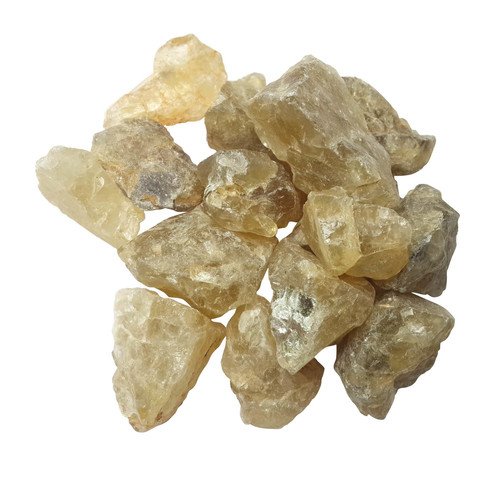
Our Yellow Sapphire Rough product photographs provide a visual reference for the material’s unfinished appearance.
The pictured stones show irregular rough forms, pale yellow to deeper golden-brown coloration, and areas that appear translucent under the available lighting. Their surfaces retain an unpolished appearance rather than the uniform reflective finish of a faceted gemstone.
These characteristics illustrate why rough gemstones can appeal to collectors and lapidaries who want to examine the material before deciding how to use it.
However, a photograph alone cannot conclusively establish a stone’s mineral identity, natural origin, exact color grade, clarity, geographical origin, or treatment status. Lighting, camera settings, and screen displays can also affect the appearance of color and transparency.
Buyers should request clear photographs or videos of the actual stones, together with available weight, dimensions, product details, and relevant gemological documentation.
Natural Yellow Sapphire Rough vs. Synthetic Yellow Sapphire
Natural and laboratory-grown Yellow Sapphire can share the same fundamental chemical composition and crystal structure.
Natural sapphire forms through geological processes over time. Synthetic sapphire is produced in a controlled laboratory environment using methods such as flame fusion or other crystal-growth techniques.
Although both may be corundum, their origins differ.
Professional gemologists can examine internal growth features, inclusions, and other diagnostic characteristics to help distinguish natural from synthetic material.
What About Treatments?
Yellow Sapphire may undergo heat treatment to modify its color or appearance. Other treatments may also exist, depending on the material and processing method.
Treatment status matters because it can affect market value, disclosure requirements, and buyer expectations.
A stone should not be described as natural, untreated, or certified without appropriate supporting evidence. Visual appearance alone is insufficient to establish these claims.
For valuable purchases, consider independent gemological testing and request written disclosure of any known treatments.
How Is Yellow Sapphire Rough Formed?
Corundum forms in geological environments where the chemical conditions allow aluminum oxide to crystallize while limiting the availability of elements that would favor other minerals.
Sapphire deposits can occur in certain metamorphic rocks, some igneous-related environments, and secondary deposits formed when weathering releases durable crystals from their original host rocks.
Natural erosion and water movement may transport resistant sapphire crystals into river gravels and other alluvial deposits.
Yellow coloration develops through trace-element chemistry and crystal defects. Iron-related impurities can play an important role in the appearance of yellow corundum.
The exact formation history of an individual specimen cannot reliably be determined from color or rough shape alone.
Uses of Yellow Sapphire Rough
Yellow Sapphire Rough offers several potential applications, depending on its quality and characteristics.
1. Gemstone Cutting and Faceting
Transparent material with suitable color distribution and limited structural weaknesses may be considered for faceted gemstones.
A lapidary evaluates the rough’s shape, inclusions, fractures, and orientation before deciding how to cut it.
2. Jewellery Manufacturing
Yellow Sapphire is used in rings, pendants, earrings, and other jewellery.
For jewellery production, rough material must first be evaluated and, where appropriate, cut and polished. The suitability of the finished stone depends on its durability, dimensions, and overall quality.
3. Gemstone Collecting
Collectors may appreciate rough sapphire for its mineral characteristics, unusual crystal form, or color.
4. Mineral Display and Education
Rough specimens can be used in mineral collections, educational displays, and demonstrations of gemstone cutting.
5. Lapidary Practice
Suitable material may be useful for learning or practicing gemstone shaping, cutting, and polishing techniques.
The potential yield of a finished gemstone varies considerably. A large rough stone does not necessarily produce a large faceted stone because cutting removes material and may require eliminating fractures or inclusions.
Yellow Sapphire Rough Quality Factors
Evaluating rough sapphire involves more than looking at its color or total weight.
Color and distribution: Buyers should assess the intensity, consistency, and visual appeal of the yellow coloration.
Transparency: More transparent material may offer greater potential for faceting, although other factors remain important.
Internal inclusions: Mineral inclusions, growth features, and other internal characteristics can affect appearance and cutting decisions.
Fractures and surface damage: Existing fractures can reduce the amount of usable material and increase cutting risks.
Crystal shape and dimensions: The shape determines how a cutter might orient and plan the finished gemstone.
Carat weight and total weight: One carat equals 0.2 grams. Buyers should clarify whether the listed weight refers to an individual stone or an entire parcel.
Potential cutting yield: The amount of finished gemstone obtainable from the rough depends on its shape, quality, inclusions, and the cutter’s design.
Origin and treatment: Verified information about geographical origin and treatment may influence commercial value.
Independent verification: Gemological reports can provide additional confidence when their scope and findings are appropriate to the purchase.
Yellow Sapphire Rough Price and Value
The Yellow Sapphire Rough Price depends on multiple factors, and no single price applies to every specimen.
Important considerations include:
- Color intensity and distribution.
- Transparency and clarity.
- Size, weight, and crystal shape.
- Fractures and other structural weaknesses.
- Potential yield after cutting.
- Natural or synthetic origin.
- Known heat treatment or other treatments.
- Verified geographical origin, where relevant.
- Documentation, market demand, and seller terms.
Two stones with identical weights may have very different values if one offers better transparency, more attractive color, fewer fractures, or a higher expected cutting yield.
Likewise, a large opaque specimen may have a different market position from a smaller, transparent stone suitable for precision faceting.
How to Request an Accurate Quotation
For a meaningful quotation, provide or request the following information:
- Individual stone weight or total parcel weight.
- Dimensions in millimeters.
- Clear photographs under neutral lighting.
- Available transparency and quality observations.
- Known origin and treatment information.
- Relevant laboratory reports, if available.
- Intended use, such as cutting, collecting, or display.
For wholesale purchases, buyers should also clarify minimum order quantities, parcel consistency, shipping arrangements, payment terms, and return policies.
Contact the seller for a quotation based on the actual material rather than relying on a generic online price.
Yellow Sapphire Rough Benefits and Astrological Beliefs
In Vedic astrology, Yellow Sapphire, or Pukhraj, is traditionally associated with Jupiter, known as Guru or Brihaspati.
Within these traditions, Jupiter is linked with knowledge, wisdom, prosperity, learning, and spiritual development. Some practitioners recommend Pukhraj according to an individual’s astrological chart.
These associations are matters of cultural and astrological belief rather than established scientific effects.
There is no reliable scientific evidence that wearing or owning Yellow Sapphire guarantees wealth, marriage, career advancement, improved health, or other specific life outcomes.
Buyers interested in Pukhraj for traditional or spiritual reasons should distinguish these beliefs from the gemstone’s independently assessable mineral properties.
How to Identify Yellow Sapphire Rough
Visual inspection can help identify features worth investigating, but it cannot conclusively establish whether a stone is natural sapphire.
Color, rough shape, surface appearance, and apparent transparency are not sufficient authentication methods.
A qualified gemologist may use several techniques, including:
- Refractive index testing: Measures how light behaves within the material.
- Microscopic examination: Reveals inclusions, growth features, fractures, and other internal characteristics.
- Spectroscopy: Can help investigate color-related features and identify diagnostic absorption patterns.
- Specific gravity testing: Provides a useful physical measurement when suitable methods can be applied.
- Advanced laboratory testing: May be required to distinguish natural from synthetic material or investigate certain treatments.
Not every test is appropriate for every rough specimen, and the final conclusion depends on the evidence available.
Avoid relying on scratch tests, glass tests, or other improvised home methods. These can damage the specimen and do not reliably establish its identity.
For valuable transactions, an independent report from a reputable gemological laboratory can provide stronger evidence than appearance alone.
How to Choose the Right Yellow Sapphire Rough
Before buying Raw Yellow Sapphire, consider the following checklist.
- Define your purpose: Decide whether the stone is intended for cutting, collecting, display, jewellery production, or traditional astrological use.
- Check dimensions: Request measurements in millimeters rather than relying only on photographs.
- Confirm weight: Clarify the individual weight and total parcel weight.
- Evaluate color: Request photographs under consistent, neutral lighting.
- Assess transparency: Determine whether the material is transparent, translucent, or opaque.
- Ask about fractures: Request close-up images of visible cracks and damaged areas.
- Review cutting potential: If purchasing for faceting, seek an experienced lapidary’s assessment.
- Clarify origin and treatments: Ask which claims are documented and which remain unverified.
- Review documentation: Check whether a gemological report is available and what it actually confirms.
- Check seller policies: Confirm pricing, shipping, returns, and the availability of actual product photographs.
For wholesale orders, request details about parcel consistency, available quantities, and inspection arrangements before committing to a purchase.
How to Store and Care for Yellow Sapphire Rough
Yellow Sapphire is relatively hard, but rough specimens can still chip or fracture, particularly along existing cracks or weak crystal boundaries.
Follow these basic care recommendations:
- Store each specimen separately in a padded compartment or suitable protective container.
- Avoid allowing stones to knock against one another during storage or transportation.
- Handle rough crystals carefully because sharp or irregular edges may cause minor cuts.
- When appropriate, clean the specimen with lukewarm water, a small amount of mild soap, and a soft brush.
- Rinse gently and dry with a soft, lint-free cloth.
- Avoid harsh chemicals and unverified cleaning treatments.
- Do not use ultrasonic or steam cleaners unless the stone’s characteristics and any treatments have been assessed by a qualified professional.
For specimens with fractures, coatings, attached matrix, or uncertain treatments, seek specialist advice before cleaning.
Yellow Sapphire Rough for Gemstone Businesses
Yellow Sapphire Rough can interest gemstone cutters, jewellery manufacturers, lapidaries, wholesalers, retailers, and mineral collectors.
For cutters, the main consideration is the potential amount and quality of finished gemstone material. For manufacturers, the rough must suit the intended jewellery design and production requirements.
Wholesalers and retailers may also evaluate parcel consistency, documentation, customer demand, and the reliability of product information.
Businesses purchasing multiple stones should examine representative specimens carefully and clarify whether the parcel is sold by individual piece, total weight, or another agreed specification.
An important buying principle is to evaluate the actual rough before estimating finished-gemstone yield or commercial value. Photographs can help with initial screening, but they cannot replace physical inspection or suitable gemological testing.
Product Information: Yellow Sapphire Rough
Explore the available Yellow Sapphire Rough offered by [Your Brand Name].
- Product Name: Yellow Sapphire Rough
- Brand: [Your Brand Name]
- Available Weight: [Enter Weight]
- Available Sizes: [Enter Sizes]
- Product Origin: [Enter Verified Origin]
- Certification: [Enter Verified Certification Details]
- Price: [Enter Price or Write “Contact Us for a Quote”]
- Contact Details: [Enter Contact Information]
- Website: [Enter Website URL]
Availability, dimensions, documentation, and other product specifications should be confirmed for the actual stones before purchase.
Whether you are a gemstone collector, a jewellery manufacturer, or a lapidary looking for suitable material, reviewing the individual specimen can help you make a more informed decision.
Conclusion
Yellow Sapphire Rough offers an opportunity to explore the color, crystal structure, and potential applications of an important gemstone variety. From faceting and jewellery manufacturing to mineral collecting and display, its suitability depends on the characteristics of each individual stone.
Understanding gemological properties, quality factors, cutting potential, treatment disclosure, and verification methods helps buyers assess rough sapphire more confidently.
If you are interested in purchasing Yellow Sapphire Rough or Raw Pukhraj Stone, contact [Your Brand Name] to enquire about current availability. Request actual product photographs, confirm the dimensions and weight, ask about verified origin and treatment information, and enquire about gemological testing or documentation where available.
Contact us for product details and a quotation tailored to your requirements.
