


Introduction to Natural Spinel
The natural spinel gemstone is a beautiful and versatile mineral prized for its remarkable range of colors, attractive brilliance, and fascinating history. Available in shades of red, pink, purple, violet, blue, orange, gray, and black, spinel offers gemstone collectors and jewelry enthusiasts an impressive variety of choices.
For centuries, red spinel was frequently mistaken for ruby. Some historic gemstones treasured by royalty as rubies were eventually identified as spinels, helping establish the mineral’s distinctive place in gemology. Today, natural spinel is appreciated in its own right for its color, durability, geological characteristics, and suitability for fine jewelry.
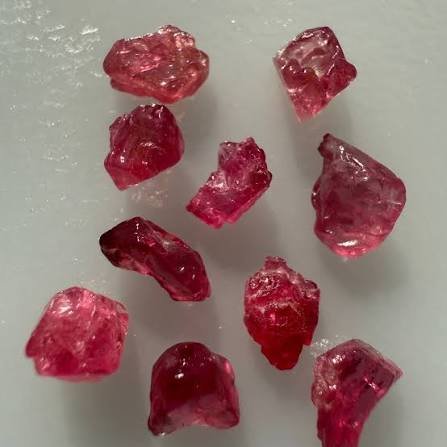
Natural spinel is also interesting in its uncut form. Rough natural spinel specimens can display distinctive crystal shapes, irregular surfaces, mineral inclusions, and colors that appeal to mineral collectors, lapidaries, and gemstone enthusiasts.
Whether you are searching for a red spinel gemstone, a vibrant pink spinel, a blue faceted stone, or rough spinel for sale, understanding its properties and quality factors can help you make an informed purchase.
This guide explains the history, colors, physical properties, identification, value, care, and buying considerations associated with natural spinel.
Important buying note: A specimen’s appearance alone does not establish its mineral identity, geographical origin, or treatment status. Buyers seeking verified natural spinel should request appropriate documentation when reliable identification is important.
1. What Is Natural Spinel?
Natural spinel is a mineral that forms through geological processes in the Earth’s crust. Its chemical composition is primarily magnesium aluminum oxide, represented by the formula MgAl₂O₄.
Gem-quality spinel is valued for its attractive colors, transparency, brilliance, and relatively good hardness. It can occur as individual crystals in geological environments and may also be recovered from secondary deposits where weathering has released crystals from their original host rocks.
Spinel belongs to the cubic crystal system. This crystal structure contributes to its optical behavior, including its single refractive index under normal gemological examination.
Why Is Natural Spinel Special?
Several characteristics make spinel appealing:
- Color variety: It occurs in numerous colors, from vivid red and hot pink to violet, blue, and orange.
- Attractive brilliance: Transparent, well-cut spinel can produce lively reflections.
- Good durability: Its Mohs hardness of approximately 8 makes it suitable for many types of jewelry.
- Historical significance: Famous red spinels have been treasured in royal collections.
- Collecting interest: Natural crystals and unusual specimens can appeal to mineral collectors as well as gemstone buyers.
Natural spinel is different from synthetic spinel. Natural material forms through geological processes, whereas synthetic spinel is grown in a laboratory. Although the two can share similar chemical compositions and physical properties, their formation histories differ.
2. History and Origin of Spinel
A Gemstone Once Mistaken for Ruby
Spinel has a long history in jewelry, royal collections, and international gemstone trading. Before modern gemological testing, people often identified gemstones primarily through their appearance. Because red spinel and ruby can look remarkably similar, the two minerals were frequently confused.
Historically, some red spinels were called Balas rubies. This name reflected their resemblance to ruby rather than their actual mineral identity.
A famous example is the Black Prince’s Ruby, a large red spinel set in the British Imperial State Crown. Another historic gemstone, the Timur Ruby, is also a spinel. These examples demonstrate why visual appearance alone is not a dependable method of mineral identification.
The mineralogical distinction between spinel and ruby became established through scientific investigation, including work by Jean-Baptiste Louis Rome de Lisle in the eighteenth century.
Major Natural Spinel Sources
Natural spinel has been found in several countries, including:
- Myanmar: Historically important for fine red and vivid pink spinel.
- Sri Lanka: Known for a variety of colored gemstones, including spinel.
- Vietnam: A recognized source of red, pink, and other colored spinels.
- Tanzania: Known for colored spinel, including attractive blue material.
- Tajikistan: Historically associated with important red and pink spinel deposits.
- Madagascar: An additional source of gem-quality spinel.
- Pakistan and Afghanistan: Known for various gem-bearing deposits, including spinel.
These are recognized sources, not proof of the origin of any particular specimen.
Does Origin Affect Value?
Yes, geographical origin can influence market interest, particularly for certain colors and historically important sources. However, origin alone does not determine a gemstone’s quality or price.
Color, clarity, size, cutting quality, treatment status, and reliable documentation also matter. Furthermore, an origin claim should not be treated as verified unless supported by appropriate evidence.
For buyers of rough natural spinel, a seller’s description of a mining locality should be distinguished from a laboratory-confirmed origin determination.
3. Colors of Natural Spinel
One of the greatest attractions of natural spinel is its wide color range. Different colors appeal to different buyers, and commercial demand varies according to market preferences and the characteristics of individual stones.
Red Spinel
Red spinel is among the most historically celebrated varieties. Its color can range from bright crimson and scarlet to deep red.
Chromium is an important coloring element in many red spinels. Fine red material with strong saturation and attractive brightness can be highly desirable to collectors and jewelry buyers.
Pink Spinel
Pink spinel ranges from delicate pastel pink to intense, saturated pink. Lighter shades may suit understated jewelry, while vivid pink stones can create striking centerpieces.
The value of a pink spinel depends on its individual appearance, including color strength, clarity, transparency, and size.
Hot Pink Spinel
Hot pink spinel is particularly appealing to buyers seeking bright, expressive gemstone colors.
However, the term hot pink is a commercial color description rather than a separate mineral species. Its use does not establish authenticity, origin, or quality.
Purple and Violet Spinel
Purple and violet spinels can display shades ranging from light lavender to rich violet and bluish purple.
These colors appeal to collectors and jewelry designers seeking alternatives to more familiar purple gemstones.
Blue Spinel
Blue spinel ranges from light blue and grayish blue to deeper, more saturated blue.
Some cobalt-colored blue spinels are especially prized. However, not every blue spinel has the same market demand; color intensity, appearance, size, and quality remain important.
Gray and Black Spinel
Gray and black spinel can offer a more understated appearance than bright red or pink varieties.
These colors may appeal to contemporary jewelry designers, collectors, and buyers who prefer dark gemstones.
A dark specimen should not automatically be assumed to be a particular spinel variety without reliable identification.
Orange and Other Less Common Colors
Spinel can also occur in orange and orange-red shades, as well as other less common color variations.
Certain stones may show unusual optical effects, including asterism or chatoyancy, although these effects are not present in every specimen.
What Determines Spinel Color?
Color depends on the stone’s chemical composition, including trace elements, and on how those elements interact with light.
Commercial value is influenced by the desirability of the particular color, its saturation, brightness, consistency, and the overall quality of the stone.
A vivid color may increase a stone’s appeal, but color alone cannot establish its value.
4. Natural Spinel Properties: Gemological Facts
The following table summarizes typical gemological properties of spinel. Values can vary somewhat with composition and measurement conditions.
| Property | Typical description |
|---|---|
| Mineral species | Spinel |
| Chemical formula | MgAl₂O₄ |
| Crystal system | Cubic |
| Mohs hardness | Approximately 8 |
| Refractive index | Commonly around 1.718–1.738, depending on composition |
| Specific gravity | Approximately 3.58–3.61 for many gem-quality examples |
| Luster | Vitreous, or glass-like |
| Transparency | Transparent to opaque |
| Cleavage | No distinct cleavage commonly observed in gem-quality spinel |
| Fracture | Uneven to conchoidal |
| Typical crystal habit | Octahedral crystals; other habits and crystal combinations may occur |
| Optical character | Isotropic under normal conditions |
| Jewelry suitability | Good for many jewelry applications when properly selected and set |
These are reference characteristics, not measurements of any particular specimen. A qualified gemologist may need to perform testing to establish the identity and characteristics of an individual stone.
Is Spinel Durable?
With a Mohs hardness of approximately 8, spinel is harder than many common minerals and is suitable for rings, pendants, earrings, and other jewelry.
However, hardness measures resistance to scratching, not complete resistance to damage. Spinel can still chip or fracture if struck, especially around vulnerable edges or where substantial fractures are present.
For everyday rings, a protective setting and sensible wear habits are advisable.
5. Rough Natural Spinel vs. Cut and Polished Spinel
Rough natural spinel refers to material that has not been fashioned into a finished gemstone. Depending on its condition, rough material may retain natural crystal faces, irregular surfaces, weathering, attached matrix, or visible inclusions.
Faceted spinel, by contrast, has been shaped and polished to improve its appearance and manage the way it interacts with light.
How Do Lapidaries Evaluate Rough Spinel?
A lapidary is a specialist who cuts and polishes gemstones.
Before cutting rough spinel, a lapidary generally considers several factors:
- Color: Is the color attractive, and is it likely to remain attractive after cutting?
- Transparency: Is the material sufficiently transparent for the intended finished product?
- Clarity: Are inclusions or fractures likely to affect the finished stone?
- Crystal shape: Does the shape provide a practical starting point for cutting?
- Size: Is the specimen large enough for the intended cut and finished dimensions?
- Fractures: Could internal weaknesses cause material loss during cutting?
- Potential yield: How much usable finished gemstone might remain?
- Market demand: Is there likely to be demand for the expected finished color, size, and shape?
How Much Rough Spinel Remains After Cutting?
Cutting removes material to eliminate damaged areas, shape the stone, and create suitable facets.
The final yield varies considerably. It depends on the original shape, the distribution of inclusions, fractures, color zoning, cutting design, and the lapidary’s objectives.
Consequently, a rough specimen’s weight cannot be converted into a reliable finished-carat estimate without examining the actual material.
A large rough crystal is not automatically more valuable than a smaller one. A smaller crystal with attractive color, transparency, and favorable cutting potential may be more desirable than a larger but heavily fractured specimen.
Buying Rough Spinel Responsibly
When purchasing rough spinel, request clear photographs from multiple angles, approximate dimensions, weight, and an honest description of visible fractures and inclusions.
If the material has not been professionally identified, its identity should be described as unverified rather than guaranteed.
Buyers should also distinguish between a specimen intended for mineral collecting and material being sold primarily for cutting. These uses involve different quality requirements.
6. Natural Spinel vs. Ruby
Red spinel and ruby can look similar, but they are different minerals.
Ruby is the red variety of corundum, while spinel is a magnesium aluminum oxide mineral. Both can produce beautiful red gemstones, but their chemical compositions and optical properties differ.
| Feature | Natural Spinel | Ruby |
|---|---|---|
| Mineral | Spinel | Corundum |
| Chemical composition | Magnesium aluminum oxide, MgAl₂O₄ | Aluminum oxide, Al₂O₃ |
| Typical color | Red, pink, purple, blue, orange, and other colors | Primarily red |
| Mohs hardness | Approximately 8 | 9 |
| Crystal system | Cubic | Trigonal |
| Optical character | Normally isotropic | Anisotropic and doubly refractive |
| Appearance | Can be vivid, transparent, and brilliant | Can be vivid, transparent, and brilliant |
| Historical relationship | Sometimes mistaken for ruby | Historically confused with red spinel |
| Market value | Depends on color, clarity, size, and other factors | Depends on color, clarity, size, treatment, origin claims, and other factors |
| Identification | Requires appropriate gemological examination when certainty matters | Requires appropriate gemological examination when certainty matters |
Which Is More Valuable?
There is no universal price relationship for every spinel and ruby.
Fine rubies can command exceptional prices, while top-quality red or blue spinels can also be valuable. Commercial-grade examples of either mineral may be substantially less expensive than exceptional specimens.
The meaningful comparison is between individual stones of comparable quality, with attention to treatment status, size, documentation, and market demand.
7. Natural Spinel vs. Synthetic Spinel
Synthetic spinel is laboratory-grown spinel produced through controlled manufacturing processes. It can have a chemical composition and crystal structure similar to those of natural spinel.
One important distinction is that synthetic does not mean imitation. A synthetic gemstone is a laboratory-grown counterpart of a natural material. An imitation, by contrast, is a different material used to resemble another gemstone.
How Is Synthetic Spinel Made?
Synthetic spinel has been produced using methods including flame fusion and, in some cases, flux growth.
Flame-fusion material has been widely used to imitate other gemstones because it can be manufactured in a range of colors. Some laboratory-grown spinels have growth features that differ from those commonly encountered in natural specimens.
How Can Natural Spinel Be Distinguished from Synthetic Spinel?
Gemologists may examine:
- Internal inclusions and growth features.
- Features associated with crystal growth.
- Refractive index and other physical properties.
- Microscopic characteristics.
- Spectroscopic evidence, when appropriate.
- Other observations relevant to the specimen.
Not every natural stone contains obvious inclusions, and not every synthetic stone displays easily recognized features.
Visual inspection alone cannot reliably establish natural origin in every case.
If the distinction matters for a valuable purchase, resale, insurance, or collection documentation, obtain an assessment from a qualified gemological laboratory.
8. Benefits and Uses of Natural Spinel
Natural spinel has several established practical uses and areas of interest.
Jewelry Applications
Faceted spinel can be used in rings, pendants, earrings, necklaces, and other jewelry designs.
Its range of colors gives designers flexibility when creating traditional or contemporary pieces. Good hardness also makes it suitable for many jewelry applications, although individual stones should be evaluated for fractures and other vulnerabilities.
Gemstone Collecting
Collectors may seek spinel for its color, rarity within particular quality categories, crystal characteristics, history, or documented provenance.
Rough crystals can be attractive additions to mineral collections even when they are not suitable for faceting.
Lapidary and Gemstone Cutting
Lapidaries may select rough spinel for cutting based on its color, transparency, crystal size, and potential yield.
The final result depends on the material and the skill of the cutter.
Decorative and Mineralogical Interest
Natural crystals can provide an opportunity to study mineral formation, crystal habit, and the geological processes that produce gemstones.
Traditional Beliefs and Scientific Evidence
Some cultures associate gemstones with symbolic meanings, protection, harmony, or personal well-being.
These beliefs are part of cultural and historical traditions. They should not be confused with scientifically established effects.
There is no reliable scientific basis for claiming that natural spinel guarantees healing, wealth, investment returns, or astrological outcomes.
9. Natural Spinel Quality Factors
Evaluating natural spinel requires considering the complete stone or specimen rather than relying on a single characteristic.
Color and Saturation
Color is often one of the most influential factors in the value of faceted spinel.
A desirable color usually combines attractive hue, suitable saturation, and good brightness. However, preferences differ among buyers and markets.
Clarity and Inclusions
Inclusions are internal features within a gemstone. Some are natural indicators of the stone’s formation, while fractures and certain other inclusions can affect durability.
The importance of an inclusion depends on its size, position, visibility, and potential impact on the finished stone.
Transparency
Transparent material is generally preferred for traditional faceted gemstones, although translucent or opaque specimens can have collecting or decorative appeal.
Cut and Proportions
For faceted spinel, cutting influences brilliance, symmetry, appearance, and weight retention.
An attractive cut should balance visual performance with the characteristics of the original rough material.
Carat Weight and Crystal Size
Carat weight is particularly relevant to finished gemstones.
For rough spinel, crystal dimensions, shape, condition, and potential cutting yield may be more useful than weight alone.
Treatment Status
Buyers should understand whether the gemstone is natural, whether any treatments are known or detected, and whether the seller has supporting documentation.
Natural origin and untreated status are separate questions.
Provenance and Documentation
Provenance refers to a stone’s documented history or source information. A geographical origin claim is not the same as proof of mineral identity.
Where available, reliable laboratory documentation can help establish identity and may address detectable treatments or origin.
The key principle: Assess every specimen individually. Color, size, or a seller’s origin claim should never replace a complete quality assessment.
10. Natural Spinel Price and Value
Natural spinel prices vary widely because gemstones differ in quality, appearance, size, and market desirability.
Rather than applying one price per carat to every stone, buyers and sellers should consider the characteristics of the specific material.
What Influences Natural Spinel Price?
Important factors include:
- Color: Vivid red, attractive pink, and certain blue spinels can attract strong demand.
- Clarity: Eye-clean faceted stones may be more desirable, although acceptable inclusions depend on the material.
- Transparency: The degree of transparency influences suitability for different uses.
- Size: Larger fine-quality stones can be difficult to find.
- Cut: Proportions, symmetry, brilliance, and finished weight influence value.
- Origin: Credibly established origin may affect market interest.
- Treatment status: Buyers may value documented treatment information when comparing stones.
- Certification: Laboratory reports can increase confidence in identification, although they do not guarantee a particular selling price.
- Market demand: Preferences change over time and differ between markets.
Rough Spinel vs. Faceted Spinel Pricing
Rough spinel and finished gemstones should not be valued using identical assumptions.
A faceted stone has already undergone selection, cutting, and polishing. Its value reflects the finished product’s appearance and characteristics.
Rough material must be assessed according to its condition, likely use, and potential yield. Cutting costs, the possibility of material loss, and uncertainty about the finished result also matter.
A rough specimen that appears large may yield a much smaller faceted stone, or it may be more appropriate as a mineral specimen.
Is Natural Spinel a Good Investment?
Spinel can be collected for enjoyment, historical interest, or appreciation of its mineralogical characteristics. However, its future resale price cannot be guaranteed.
Gemstones may involve substantial buying and selling spreads, uncertain demand, and difficulty verifying quality or provenance.
Buy natural spinel because its characteristics and price suit your objectives, not because of promises of guaranteed financial appreciation.
11. How to Identify Genuine Natural Spinel
Natural spinel identification requires distinguishing the mineral itself from look-alikes, imitations, and laboratory-grown material.
Preliminary Visual Observations
Color, transparency, crystal shape, surface appearance, and inclusions may provide useful clues.
However, these observations are preliminary. Other minerals can resemble spinel, and synthetic materials may look very convincing.
Rough crystals with attractive octahedral shapes can be visually suggestive, but crystal shape alone does not prove identity.
Professional Gemological Testing
Depending on the specimen, a gemologist may use:
Magnification: Microscopic examination can reveal inclusions, fractures, and growth features.
Refractive index measurement: A refractometer can help assess whether a transparent gemstone’s optical properties are consistent with spinel.
Specific gravity: Density measurements may provide additional evidence when suitable methods can be applied.
Spectroscopy: Optical absorption patterns can help characterize coloring elements and distinguish some gem materials.
Advanced laboratory examination: Additional methods may be needed to investigate natural versus synthetic origin, detectable treatments, or geographical origin.
No single simple home test can reliably establish every aspect of a gemstone’s identity.
Why Laboratory Reports Matter
A laboratory report can provide independent information about the identity of a gemstone and, depending on the laboratory and service requested, may address treatment or origin.
Not every report covers every question. Buyers should read the report’s actual findings and limitations rather than assuming that certification automatically proves all seller claims.
For expensive or important purchases, verify the report with the issuing laboratory where possible.
12. Does Natural Spinel Require Treatment?
Natural spinel can be encountered in different treatment states. Buyers should not assume that every natural specimen is untreated.
Three terms are particularly important:
- Untreated natural spinel: A naturally formed gemstone for which no treatment has been applied, subject to the evidence available.
- Treated natural spinel: A naturally formed gemstone that has undergone a process intended to change or improve a characteristic.
- Synthetic spinel: A laboratory-grown material, not a naturally mined gemstone.
Treatment status and natural origin are separate characteristics. A stone can be natural and treated.
Why Is Treatment Disclosure Important?
Treatment can influence appearance, durability, market value, and buyer expectations.
Ask the seller to disclose any known treatment and explain whether the statement is based on laboratory testing, supplier information, or another source.
When the distinction is commercially important, a suitable laboratory report can provide additional confidence.
If treatment status is unknown, it is more accurate to state that it has not been established than to advertise the gemstone as definitely untreated.
13. How to Buy Natural Spinel Online
Buying gemstones online can be convenient, but careful examination of the listing is essential.
Use the following checklist before purchasing.
Natural Spinel Online Buying Checklist
1. Examine photographs and videos. Look for multiple views under natural or neutral lighting. Be cautious of images that are heavily edited or that conceal important details.
2. Confirm dimensions and weight. For rough specimens, request measurements in millimeters and weight in grams or carats, as applicable.
3. Confirm the condition. Establish whether the product is rough, polished, or faceted.
4. Evaluate color and transparency. Ask whether the photographs accurately represent the specimen’s appearance and whether its color varies under different lighting.
5. Ask about inclusions and fractures. Request additional close-up images if necessary.
6. Clarify natural or synthetic identity. Check whether the material has been professionally identified or is being sold based on preliminary assessment.
7. Ask about treatment. Look for a clear treatment disclosure and clarification of anything that remains unknown.
8. Review laboratory documentation. For higher-value purchases, request a relevant report when available.
9. Read the return policy. Confirm the return period, eligibility conditions, shipping arrangements, and refund terms.
10. Evaluate seller reputation. Consider reviews, communication, product descriptions, and the seller’s willingness to answer questions.
11. Check origin claims. A claimed source should not be treated as independently verified without appropriate evidence.
12. Compare the actual specimen, not just the category. Two pieces described as red spinel can differ considerably in quality, condition, and suitability for cutting.
A trustworthy seller should communicate clearly, provide accurate photographs, disclose uncertainties, and avoid guarantees that cannot be substantiated.
14. How to Care for Natural Spinel
Proper care helps preserve the appearance of spinel jewelry and mineral specimens.
Cleaning Spinel
For a durable, untreated gemstone without significant fractures, gentle cleaning with lukewarm water, mild soap, and a soft brush is a conservative approach.
Rinse carefully and dry with a soft, lint-free cloth.
If the stone has unknown treatments, substantial fractures, loose settings, or attached mineral matrix, seek advice before using water or cleaning products.
Storage
Store spinel separately from softer gemstones and materials that may scratch easily.
Individual pouches or compartmentalized jewelry boxes can reduce accidental contact and abrasion.
Rough specimens should be supported securely to protect delicate crystal edges.
Everyday Jewelry Precautions
Although spinel has good hardness, avoid unnecessary impacts, abrasive surfaces, and harsh chemicals.
Remove gemstone jewelry before activities that could expose it to hard knocks or damaging substances.
Ultrasonic and steam cleaners should not be used automatically. Fractures, treatments, and setting conditions can make such methods unsuitable.
When uncertain, choose gentle cleaning and consult a qualified jeweler or gemologist.
15. Who Should Buy Natural Spinel?
Natural spinel can appeal to several different audiences.
Gemstone Collectors
Collectors may appreciate spinel’s color diversity, mineralogical features, and historical significance.
Jewelry Designers
Designers can use faceted spinel in rings, earrings, pendants, and distinctive custom jewelry.
Lapidaries
Rough material may interest lapidaries looking for suitable crystals to cut and polish, provided the material’s characteristics support their intended work.
Gemstone Enthusiasts
People who enjoy learning about minerals may appreciate the differences between spinel, ruby, and other gemstones.
Jewelry Buyers
Spinel offers colorful alternatives to more familiar gems. Its suitability depends on the buyer’s preferred appearance, budget, and intended use.
Mineral Specimen Collectors
Rough crystals may be collected for their shapes, surfaces, and geological interest, even when faceting is not the primary objective.
16. Why Explore Our Natural Spinel Collection?
Discover the visual variety of natural spinel and explore specimens that may appeal to gemstone collectors, jewelry enthusiasts, and mineral lovers.
Our natural spinel collection is intended to help customers explore the colors, shapes, and individual characteristics associated with this fascinating gemstone.
Whether you are interested in rough natural spinel for collecting, specimens for further examination, or material that may be suitable for lapidary work, choosing carefully begins with understanding the characteristics of each individual piece.
Explore the Characteristics of Individual Specimens
Natural gemstone specimens can differ in color, crystal shape, transparency, surface condition, and visible inclusions. These differences are part of what makes collecting minerals interesting.
When evaluating a specimen, review its photographs, dimensions, weight, condition, and product description.
For cutting purposes, remember that not every rough crystal will produce a transparent, high-value faceted gemstone. Suitability depends on the individual material and the lapidary’s assessment.
Transparent Product Information
We encourage customers to review the available details for each listing and ask questions when additional information is needed.
Please refer to the individual product page for:
- Brand: [Brand Name]
- Available sizes and weights: [Available Sizes]
- Price: [Price]
- Laboratory documentation: [Certification Details]
- Treatment status: [Disclosed Treatment Status]
- Geographical origin: [Origin, if documented]
- Shipping and returns: [Shipping and Return Policy]
Only information supported by the available evidence should be presented as verified.
Explore the collection to discover specimens that match your interests, whether you are a mineral collector, gemstone enthusiast, or lapidary evaluating rough material.
17. Frequently Asked Questions About Natural Spinel
1. Is natural spinel a real gemstone?
Yes. Spinel is a recognized natural mineral used as a gemstone. It occurs in several colors and is valued for its appearance, durability, and historical significance.
2. Is spinel a rare gemstone?
Spinel occurs in multiple locations, but availability varies by color, quality, size, and locality. Fine-quality stones with particularly desirable colors can be difficult to obtain.
3. Is natural spinel more affordable than ruby?
Many spinels are more affordable than comparable fine rubies, but there is no universal price relationship. Quality, size, color, treatment status, and market demand influence the price of both gemstones.
4. What colors does natural spinel come in?
Natural spinel occurs in red, pink, hot pink, purple, violet, blue, gray, black, orange, and other colors. The exact appearance depends on the individual stone’s composition and characteristics.
5. Is spinel durable enough for everyday jewelry?
Generally, yes. Spinel has a Mohs hardness of approximately 8 and is suitable for many jewelry applications. Nevertheless, stones with fractures can be vulnerable to damage, and protective settings are advisable for rings.
6. How can I identify natural spinel?
Appearance and crystal shape can provide preliminary clues, but they cannot reliably establish identity in every case. Gemological testing, microscopic examination, and, when necessary, laboratory analysis can help determine whether a stone is natural spinel.
7. Is natural spinel always untreated?
No. Natural origin does not automatically establish untreated status. Buyers should request treatment disclosures and relevant documentation when treatment status is important.
8. What is the difference between natural and synthetic spinel?
Natural spinel forms through geological processes, while synthetic spinel is grown in a laboratory. They can have similar chemical and physical properties, so appropriate testing may be required to distinguish them.
9. How is rough spinel valued?
Rough spinel is assessed according to color, transparency, crystal shape, clarity, fractures, size, condition, and potential cutting yield. Its suitability as a mineral specimen can also influence its appeal.
10. Does natural spinel have resale value?
Natural spinel can have resale value, but the amount depends on quality, documentation, market demand, and the circumstances of the sale. A future selling price or profit cannot be guaranteed.
11. Does spinel need a laboratory certificate?
Not every purchase requires a laboratory report. However, documentation can be valuable for expensive stones, important collections, and purchases where natural origin, treatment status, or identity must be established reliably.
12. How should spinel be cleaned?
For a suitable, untreated stone without significant fractures, use lukewarm water, mild soap, and a soft brush. For stones with unknown treatments, fractures, or delicate settings, use a conservative approach and consult a professional.
13. Is rough natural spinel suitable for cutting?
Some rough spinel is suitable for faceting, but not every specimen will produce a desirable finished gemstone. A lapidary should assess its color, transparency, inclusions, fractures, shape, and potential yield before cutting.
14. Does geographical origin determine spinel quality?
No. Origin can influence market interest, but it does not determine quality by itself. Color, clarity, transparency, size, condition, and other characteristics must also be evaluated.
15. Can natural spinel provide healing or financial benefits?
Some traditions associate gemstones with symbolic or spiritual meanings. However, there is no reliable scientific evidence that spinel guarantees healing, wealth, or investment appreciation.
18. Conclusion: Discover the Appeal of Natural Spinel
Natural spinel is a distinctive gemstone with a rich history, attractive color range, good hardness, and broad appeal among collectors and jewelry enthusiasts.
From vivid red spinel and hot pink spinel to blue, violet, and other colors, this mineral offers considerable variety. Rough specimens also provide opportunities for mineral collecting and lapidary exploration.
Understanding natural spinel properties, quality factors, treatment disclosure, and identification methods can help buyers make more informed decisions.
When shopping online, pay attention to photographs, measurements, condition, product descriptions, return policies, and available laboratory documentation. Remember that the value and suitability of rough material depend on the characteristics of each individual specimen.
Explore our Natural Spinel Collection to discover available specimens and review their individual characteristics.
For additional information about a particular piece, contact us at [Contact Information]. We welcome questions that help you select a specimen suited to your collecting, jewelry, or lapidary interests.
