

Introduction: What Is a Garnet Gemstone
Few gemstones are as misunderstood—and as wonderfully diverse—as Garnet.
When many people hear the word Garnet, they immediately picture a deep red gemstone. Red Garnet is indeed one of the most familiar forms, but the Garnet family extends far beyond red. Depending on its chemical composition and variety, Garnet can appear orange, yellow, green, pink, purple, brown, and other attractive shades. Some Garnets can even display unusual optical effects such as color change, asterism, or chatoyancy.
Scientifically, Garnet is not one single mineral species. It is a group of closely related minerals that share a broadly similar crystal structure but differ in chemical composition. The principal gem-bearing species include almandine, pyrope, spessartine, grossular, and andradite, while uvarovite is another important member of the Garnet group.
That diversity is one of Garnet’s greatest attractions. A buyer looking for a classic red gemstone can choose Garnet, while a collector interested in rare green or orange gems can explore varieties such as tsavorite, demantoid, and spessartine.
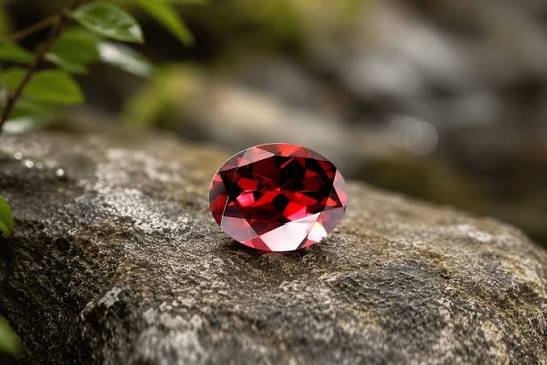
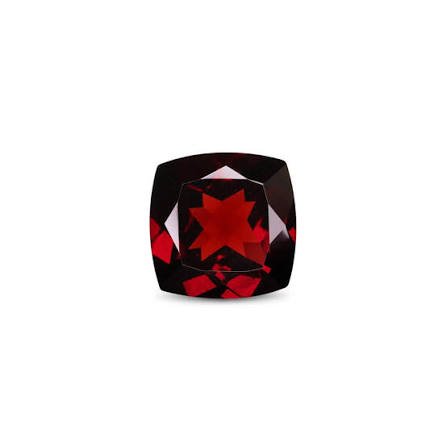
The featured gemstone in this article is presented as a polished, faceted Garnet with a red-toned appearance and attractive brilliance. Its exact variety, origin, treatment, carat weight, clarity, and quality grade should not be assumed from appearance alone. Those details require appropriate gemological documentation or testing.
What Makes Garnet Popular?
Garnet has several qualities that make it appealing to jewelry buyers and collectors:
- A broad range of natural colors
- Attractive brilliance when well cut
- Long history of jewelry use
- Several commercially important varieties
- Good durability for many jewelry applications
- Options ranging from relatively accessible stones to rare collector gems
- January birthstone status
- Strong cultural and traditional symbolism
Garnet is also the traditional birthstone for January and is associated with the second wedding anniversary.
History and Origin of Garnet
Garnet has been used as a decorative and ornamental material for thousands of years. Archaeological evidence includes a red Garnet bead necklace discovered in an Egyptian grave dating back more than 5,000 years.
Ancient and medieval societies valued red Garnets for jewelry, personal adornment, and decorative objects. In medieval Europe, red Garnets were particularly favored by members of the clergy and nobility. Later, Garnet became strongly associated with Victorian jewelry, particularly the rich red pyrope Garnets historically mined in Bohemia.
Garnet has also had an important connection with Russian jewelry. Demantoid Garnet became associated with Russian luxury jewelry and the work of Fabergé, while historic sources in Bohemia supplied Garnet for European jewelry during the 19th century.
Where Is Garnet Found?
Garnet occurs in many geological environments and is mined in numerous parts of the world. Important sources and localities have included:
- India
- Sri Lanka
- Tanzania
- Kenya
- Madagascar
- Mozambique
- Namibia
- Myanmar
- Brazil
- Russia
- Pakistan
- Afghanistan
- Iran
- Vietnam
- The United States and other countries
Different deposits are associated with different Garnet varieties, so simply knowing that a stone is “from Africa” or “from India,” for example, does not identify its species or guarantee a particular quality. GIA notes that Tanzania and Namibia are important modern sources, while Garnet has also been found in India, Sri Lanka, Kenya, Madagascar, Brazil, Russia and several other countries.
Garnet Colors: More Than Just Red
One of the biggest misconceptions about Garnet is that it is always red.
In reality, Garnet occurs in a remarkable spectrum of colors. Its color is influenced by its chemical composition and the elements present within its crystal structure.
Common Garnet Colors
| Color | Examples / Associations |
|---|---|
| Red | Almandine, pyrope and pyrope-almandine mixtures |
| Orange | Spessartine, hessonite and related materials |
| Green | Tsavorite, demantoid and other green Garnets |
| Pink | Some rhodolite and other Garnet compositions |
| Purple | Rhodolite and certain mixed-composition Garnets |
| Brown | Some grossular, almandine and other Garnets |
| Yellow | Some grossular, spessartine and andradite |
| Black | Melanite and other dark Garnet materials |
| Color-change | Certain pyrope-spessartine-related Garnets |
GIA describes Garnet as occurring in almost every color, although blue is exceptionally unusual; some Garnets can also display color-change effects under different lighting conditions.
This variety makes Garnet particularly interesting for jewelry designers and gemstone collectors.
Types of Garnet: Species vs Varieties
Understanding Garnet terminology is important when shopping.
A Garnet species is a mineral classification based primarily on chemical composition. A variety or trade name describes a particular gem material, color, or commercially recognized form within that broader group.
For example, tsavorite is not a separate Garnet species. It is the trade name for a green gem variety of grossular Garnet. Similarly, demantoid is a green variety of andradite.
Major Garnet Species
1. Almandine
Almandine is one of the most familiar Garnet species and is generally associated with deep red, reddish-purple, or dark red colors.
It is relatively common compared with some rare Garnet varieties and is widely used in jewelry.
2. Pyrope
Pyrope is traditionally associated with vivid to deep red Garnets. The name comes from the Greek pyropos, meaning “fiery-eyed.” Historic Bohemian Garnets are strongly associated with pyrope-rich material.
3. Spessartine
Spessartine is especially valued for orange and reddish-orange colors. Fine examples can display an attractive, lively appearance and are popular among collectors and jewelry enthusiasts.
4. Grossular
Grossular has one of the widest color ranges within the Garnet family. It can occur in colorless, yellow, orange, reddish-orange and green forms.
Tsavorite is the best-known green gem variety of grossular.
5. Andradite
Andradite includes some exceptionally attractive Garnets.
Its best-known gem variety is demantoid, a rare green Garnet known for high dispersion and flashes of spectral color.
6. Uvarovite
Uvarovite is a chromium-rich green Garnet. Unlike many transparent gem Garnets, it commonly occurs as small crystals or crystal aggregates and is less commonly fashioned into conventional faceted gemstones.
Important Garnet Varieties
Rhodolite: Usually a pinkish-red, purplish-red, or raspberry-like Garnet associated with pyrope-almandine compositions.
Tsavorite: A vivid green grossular Garnet.
Demantoid: A green andradite Garnet, notable for high dispersion and, in some stones, distinctive “horsetail” inclusions.
Hessonite: An orange to reddish-orange variety of grossular, sometimes displaying a characteristic internally “roiled” appearance.
The distinction between species and varieties matters because price, durability, rarity, and desirable inclusions can differ dramatically from one Garnet type to another.
Garnet Gemstone Properties
Because Garnet represents a group rather than a single mineral species, its physical properties occur within ranges.
| Property | Garnet |
|---|---|
| Mineral group | Garnet group |
| Major gem species | Almandine, pyrope, spessartine, grossular, andradite; uvarovite is another recognized species |
| General chemical formula | X₃Y₂(SiO₄)₃, with elements varying by species |
| Mohs hardness | Approximately 6.5–7.5 |
| Refractive index | Approximately 1.714–1.888 |
| Specific gravity | Approximately 3.47–4.15 |
| Crystal system | Cubic/isometric |
| Luster | Typically vitreous to resinous, depending on material |
| Transparency | Transparent to translucent and, for some materials, opaque |
| Typical colors | Red, orange, yellow, green, pink, purple, brown, black and others |
The broad range in refractive index, specific gravity, hardness and appearance reflects the chemical diversity of the Garnet group.
Garnet Gemstone Meaning and Symbolism
Garnet has accumulated a rich collection of meanings throughout history and across cultures.
Traditionally, Garnet has been associated with:
- Love
- Passion
- Friendship
- Protection
- Strength
- Commitment
- Vitality
- Courage
Red Garnet, in particular, has often been connected with warmth, passion and enduring relationships. Its historical use as a gift and jewelry stone has contributed to its romantic symbolism.
However, these meanings are cultural and traditional associations, not scientific properties. There is no scientific evidence that wearing Garnet produces a particular emotional, physical, or spiritual outcome.
Garnet Gemstone Benefits: Traditional Beliefs vs Science
Garnet gemstone benefits are frequently discussed in spiritual and crystal-healing traditions.
Depending on the tradition, Garnet may be traditionally believed to:
- Encourage confidence and motivation
- Symbolize vitality and energy
- Support feelings of passion and commitment
- Offer symbolic protection
- Encourage emotional balance
- Represent friendship and loyalty
These claims belong to spiritual, cultural, or metaphysical traditions and should not be presented as scientifically proven effects.
In particular, Garnet or any other gemstone should not be used as a replacement for professional medical diagnosis or treatment.
A trustworthy gemstone business can discuss traditional beliefs while making it clear where tradition ends and established gemological science begins.
Garnet Astrology
Garnet also appears in various gemstone-astrology traditions.
In some traditions, particular Garnets are associated with planetary energies, vitality, confidence, passion, or protection. However, there is no single universal astrological system that assigns every Garnet to the same planet or produces the same wearing recommendations.
This distinction is particularly important in South Asian gemstone traditions.
For example, hessonite Garnet, traditionally known as Gomed, is commonly associated with Rahu in Vedic astrology. Other red Garnets may be discussed differently depending on the astrological school, gemstone practitioner, and individual birth chart.
Who Traditionally Wears Garnet?
According to gemstone traditions, the appropriate Garnet depends on the variety, intended astrological purpose, and individual’s horoscope.
Traditional practices may consider:
- Birth chart
- Planetary associations
- Gemstone variety
- Metal used for the setting
- Finger or body placement
- Day and time of wearing
- Personal astrological recommendations
These practices are matters of belief and tradition rather than scientifically established effects. Anyone purchasing Garnet for astrological reasons should therefore distinguish an astrological recommendation from a gemological identification.
Garnet Jewelry: Rings, Earrings, Pendants and More
Garnet’s color diversity makes it highly versatile in jewelry.
Garnet Rings
Red Garnet rings remain classic choices, while green tsavorite and demantoid can create a more distinctive luxury look.
Because Garnet hardness varies from approximately 6.5 to 7.5, rings should be worn with reasonable care, particularly when the gemstone is exposed around the edges.
Garnet Earrings
Earrings are excellent for Garnets because they are less likely to receive hard impacts than rings.
Garnet Pendants and Necklaces
Pendants provide a beautiful way to showcase larger stones while reducing exposure to knocks and abrasion.
Garnet Bracelets
Bracelets can look elegant but receive more impact than pendants or earrings. A Garnet bracelet should therefore be handled carefully.
Which Garnets Are Best for Everyday Jewelry?
Harder Garnets such as almandine, pyrope, spessartine and tsavorite can be suitable for many jewelry applications, but no Garnet should be treated as completely damage-proof.
GIA notes that Garnet hardness varies from 6.5 to 7.5 and that toughness ranges from fair to good. Hard blows and rough wear should be avoided.
How to Choose a Good Garnet
Unlike diamonds, Garnets are not evaluated using one universal standardized grading system such as a single 4Cs scale. Quality expectations vary significantly between Garnet varieties.
1. Color
Color is usually the most important starting point.
Look for:
- Attractive hue
- Appropriate tone
- Strong but pleasing saturation
- Even distribution of color
- Good appearance under normal lighting
For some rare varieties, vivid color can have a major effect on value.
2. Clarity
Clarity requirements depend on the type.
Many red Garnets are relatively clean to the unaided eye, while some orange Garnets can contain visible inclusions. In demantoid, certain inclusions may actually be desirable rather than flaws.
3. Cut
A well-executed cut can dramatically improve brilliance.
Look for:
- Bright, lively reflections
- Good symmetry
- Even facet arrangement
- No obvious windowing
- Appropriate proportions for the material
A beautiful Garnet does not need an expensive setting to look impressive if the stone itself is well cut.
4. Carat Weight and Dimensions
Two Garnets with the same carat weight can look very different in size depending on their proportions and density.
Always check both:
- Carat weight
- Exact millimeter dimensions
Some rare Garnets become substantially more valuable as size increases because large clean crystals are difficult to obtain.
5. Transparency and Brilliance
Transparent Garnets generally offer strong visual appeal when properly cut. However, some varieties are naturally translucent or opaque and are valued for different reasons.
6. Origin
Origin can matter, especially for rare or historically important Garnets.
But origin should never be guessed from color alone. When geographic origin is important to value, an appropriate laboratory report may be necessary.
7. Natural vs Synthetic
Ask whether the stone is:
- Natural
- Synthetic
- Imitation
Do not assume that a gemstone described simply as “Garnet” is automatically natural without checking the seller’s disclosure.
8. Treatment
Ask whether any treatment has been performed.
Treatment disclosure is particularly important for higher-value purchases.
9. Certification
For a significant purchase, an independent gemological report can help confirm the gemstone identity and, depending on the report, treatment or other characteristics. GIA specifically recommends obtaining a laboratory report when in doubt about a significant Garnet purchase.
Garnet Gemstone Price: What Determines Value?
There is no single Garnet gemstone price.
The Garnet family includes relatively common stones and rare collector-quality gems, so prices can differ enormously.
The principal price factors include:
- Garnet variety
- Color
- Hue, tone and saturation
- Clarity
- Cut quality
- Carat weight
- Availability in larger sizes
- Origin, when documented and relevant
- Rarity
- Treatment status
- Certification
- Market demand
Fine tsavorite and demantoid, for example, can command much higher prices than common commercial red Garnets because of their rarity and desirable color characteristics.
A responsible seller should therefore avoid quoting one universal “Garnet price per carat.”
Important: The price of the featured stone cannot be determined from its photograph alone. Exact pricing requires information such as identity, weight, dimensions, quality, treatment status, documentation, and current market conditions.
Natural vs Synthetic Garnet
Natural Garnet
Natural Garnet forms through geological processes in the Earth. Its inclusions and chemical characteristics reflect its natural formation.
Synthetic Garnet
Synthetic gemstones are laboratory-grown materials. Some synthetic materials can have similar chemical, physical, and optical characteristics to their natural counterparts, making proper testing important.
Imitation Garnet
An imitation is a different material used to resemble Garnet. It may be glass or another gemstone or man-made material.
How Can Buyers Avoid Confusion?
Before purchasing, ask:
- Is the stone natural?
- What Garnet species or variety is it?
- Has it been treated?
- What is the carat weight?
- Are dimensions provided?
- Is a laboratory report available?
- Does the seller provide a return policy?
A transparent seller should answer these questions clearly.
How to Identify a Genuine Garnet
Visual appearance alone is not a reliable method for proving gemstone identity.
Professional gemologists can use several techniques, including:
Refractive Index
The refractive index can help distinguish Garnet from many other gemstones.
Specific Gravity
Density measurements can provide additional evidence about gemstone identity.
Microscopic Examination
A microscope can reveal inclusions, growth features, fractures, and other characteristics.
Spectroscopic Examination
Spectroscopy can reveal absorption features associated with particular gemstone compositions.
Advanced Laboratory Testing
For valuable or unusual stones, laboratories may use additional analytical techniques to determine species, treatment status, and other characteristics.
A home test can sometimes provide clues, but it should not be treated as definitive proof of a genuine Garnet. For a high-value purchase, independent gemological testing is the safest approach.
Garnet Treatments
Garnets generally have fewer treatment concerns than some other popular colored gemstones, but treatments can occur and should be disclosed.
One treatment that may occasionally be encountered is fracture filling, in which a material is introduced into surface-reaching fractures to reduce their visibility or improve apparent clarity.
Treatment can affect:
- Appearance
- Durability
- Cleaning requirements
- Value
- Insurance or resale considerations
This is why buyers should ask specifically whether the Garnet is untreated or treated rather than assuming it is untreated.
Garnet Durability
Garnet hardness generally ranges from 6.5 to 7.5 on the Mohs scale, depending on the species or variety.
That makes Garnet reasonably durable for jewelry, but it is not as scratch-resistant as ruby, sapphire, or diamond.
Garnet also has fair to good toughness, meaning that hard impacts should be avoided. Some varieties are more vulnerable than others. For example, demantoid is somewhat softer than several other commonly used Garnets.
For an everyday ring:
- Choose a protective setting when appropriate.
- Avoid wearing the ring during heavy manual work.
- Keep it away from hard impacts.
- Store it separately from harder gemstones.
How to Clean and Care for Garnet
Proper Garnet care is simple.
Safe Cleaning Method
The safest general method is:
- Prepare warm, soapy water.
- Place the Garnet jewelry in the solution.
- Gently clean with a soft brush.
- Rinse carefully.
- Dry with a soft, lint-free cloth.
GIA recommends warm soapy water as a safe cleaning method for Garnets.
What Should You Avoid?
Avoid:
- Hard impacts
- Abrasive cleaners
- Harsh chemicals
- Rough scrubbing
- Steam cleaning
- Excessive heat when treatment is uncertain
Ultrasonic cleaning is generally considered safe for many Garnets but is not recommended for stones with significant fractures or fracture filling.
Storage
Store Garnet jewelry:
- In a soft pouch or lined jewelry box
- Away from diamonds, sapphires and other harder gemstones
- Individually when possible
- Away from unnecessary impact and abrasion
If a Garnet is particularly valuable, unusual, or treated, professional cleaning is a sensible option.
Garnet vs Other Red Gemstones
Garnet is often compared with ruby, red spinel and red tourmaline.
| Feature | Garnet | Ruby | Spinel | Tourmaline |
|---|---|---|---|---|
| Typical red colors | Red to purplish, brownish or orangy red | Often vivid red to purplish red | Red, pinkish red | Red, pink-red, reddish-brown |
| Mohs hardness | About 6.5–7.5 | 9 | 8 | About 7–7.5 |
| Appearance | Often strong brilliance; varies by variety | Strong brilliance and durability | Bright, lively appearance | Broad color range and attractive brilliance |
| Rarity | Varies greatly by variety | Fine ruby can be very rare | Fine red spinel can be rare | Fine red material can be uncommon |
| General price position | Ranges from accessible to very valuable | Fine ruby can command very high prices | Usually below top ruby, but exceptional stones can be valuable | Wide range depending on color and quality |
| Typical jewelry use | Rings, earrings, pendants, necklaces | All fine jewelry, including rings | Rings, earrings, pendants | Rings, earrings, pendants |
These are broad comparisons. Individual stones can differ dramatically in value and appearance.
Garnet’s major advantage is variety: a buyer can explore several colors and styles within the same gemstone family.
Why Buy Garnet?
There are many good reasons to consider a Garnet gemstone.
Beauty
A well-cut Garnet can display excellent brilliance and rich, saturated color.
Variety
Few gemstone families offer such a wide selection of colors and appearances.
Jewelry Versatility
Garnet works beautifully in rings, earrings, pendants, bracelets and necklaces.
History
Its long history gives Garnet a strong connection to ancient jewelry, European traditions and historic fine jewelry.
Collectibility
Rare Garnets such as fine demantoid and tsavorite can be fascinating additions to a gemstone collection.
Value
Many Garnets offer an attractive combination of beauty, size and price, although rare varieties can be very expensive.
The best Garnet is not necessarily the largest or most expensive. It is the stone whose color, cut, quality, documented characteristics and price make sense for the buyer.
How to Buy Garnet Online
Buying Garnet gemstone online can be convenient, but transparency matters.
Before placing an order, check the following:
Online Garnet Buying Checklist
1. Product photographs
Look for clear, high-resolution images from multiple angles.
2. Video
A video can help demonstrate brilliance and color under movement.
3. Exact dimensions
The listing should provide measurements in millimeters.
4. Carat weight
The exact weight should be stated rather than estimated.
5. Natural or synthetic disclosure
The seller should clearly identify the material.
6. Treatment disclosure
Ask whether the stone has received any treatment.
7. Variety/species
If a seller calls a stone “Tsavorite,” “Demantoid,” “Rhodolite,” or another specific name, there should be a reasonable basis for that identification.
8. Certification
For significant purchases, consider an independent laboratory report.
9. Return policy
Read the return and inspection terms before buying.
10. Seller reputation
Look for transparent product descriptions, established customer service and clear business information.
A trustworthy Garnet gemstone online listing should tell you what the seller actually knows about the stone—not make assumptions that cannot be supported.
Garnet Gemstone FAQs
1. Is Garnet a precious or semi-precious gemstone?
Garnet is commonly described in the jewelry trade as a semi-precious gemstone, although this terminology is somewhat outdated and does not accurately reflect the value of every Garnet. Fine demantoid and tsavorite, for example, can be highly valuable.
2. Is Garnet always red?
No. Garnet can be red, orange, yellow, green, pink, purple, brown, black and other colors. Some Garnets can also display color-change effects.
3. Is Garnet good for everyday wear?
It can be, particularly in appropriately designed jewelry. However, Garnet is softer than ruby and sapphire, and hardness varies by variety. Rings should receive more care than earrings or pendants.
4. How hard is Garnet?
Garnet hardness generally ranges from approximately 6.5 to 7.5 on the Mohs scale, depending on its composition.
5. Is Garnet suitable for rings?
Yes, Garnet is widely used in rings. Because it is less scratch-resistant than ruby or sapphire, protective settings and sensible everyday care are recommended.
6. How can I tell if Garnet is natural?
The most reliable approach is professional gemological testing. Refractive index, specific gravity, microscopy and spectroscopy can help identify Garnet and distinguish it from imitations or other materials.
7. Is Garnet expensive?
It depends. Common red Garnets can be relatively affordable, while rare and fine-quality varieties such as tsavorite and demantoid can command substantially higher prices.
8. Which Garnet is the rarest?
There is no single answer that applies to every definition of “rarest.” Some Garnet species and varieties are exceptionally uncommon. Fine demantoid and tsavorite are among the best-known rare and valuable gem Garnets, while unusual color-change Garnets can also be highly collectible.
9. Can Garnet be worn according to astrology?
Yes, Garnet is used in several astrological traditions. However, recommendations vary by tradition and variety. Hessonite Garnet, or Gomed, is traditionally associated with Rahu in Vedic astrology. Astrological effects are matters of belief rather than scientifically established facts.
10. How should Garnet be cleaned?
Warm, soapy water and gentle cleaning are generally the safest approach. Avoid harsh chemicals, hard impacts and steam cleaning. Treatment or fracture-filled stones may require additional care.
11. Does Garnet need certification?
Not every inexpensive Garnet requires a laboratory report. For expensive, rare, unusually marketed or investment-oriented stones, however, an independent gemological report can provide valuable assurance.
12. What is the difference between Garnet and Ruby?
Ruby is a variety of corundum and has a Mohs hardness of 9. Garnet is a mineral group with hardness generally between 6.5 and 7.5. Fine ruby is generally rarer and can be much more expensive, while Garnet offers much greater variety in species and color.
13. What is the difference between Tsavorite and Demantoid?
Tsavorite is a green variety of grossular Garnet, while demantoid is a green variety of andradite Garnet. Demantoid has higher refractive index and dispersion, contributing to its famous fire.
14. What is Rhodolite Garnet?
Rhodolite is a commercially recognized Garnet variety generally associated with pyrope-almandine compositions and attractive pinkish-red to purplish-red colors.
15. Is a dark red Garnet automatically better?
No. Darker color does not automatically mean higher quality. Garnet should be evaluated according to its variety, color attractiveness, brightness, clarity, cut and intended use.
16. Can Garnet have inclusions?
Yes. Inclusions are natural features found in many gemstones. Their importance depends on the variety. Some inclusions may reduce value, while distinctive inclusions—such as certain demantoid “horsetails”—can sometimes increase desirability.
Final Thoughts: Is Garnet the Right Gemstone for You?
Garnet is far more than a traditional red gemstone.
It is an entire family of minerals offering remarkable diversity in color, appearance, rarity and price. From classic red almandine and pyrope to vivid orange spessartine, romantic rhodolite, green tsavorite and fiery demantoid, there is a Garnet for a wide range of jewelry styles and collecting interests.
Its history stretches back thousands of years, while its modern appeal comes from the same qualities that attracted earlier generations: color, brilliance, versatility and character.
For buyers, the key is to look beyond the word “Garnet.” Ask which Garnet, how it has been cut, whether it is natural or synthetic, whether it has been treated, what its measurements and weight are, and whether independent documentation is available when appropriate.
And most importantly, buy based on transparent information rather than exaggerated promises.
Find the Right Garnet Gemstone for You
Whether you are searching for a classic red Garnet, a distinctive color variety, a meaningful birthstone, a jewelry centerpiece, or a gemstone for your collection, choosing the right stone starts with understanding its characteristics.
At our gemstone business, we believe Garnet should be appreciated for its natural beauty, individuality and versatility—not through unsupported claims.
Explore our Garnet gemstone collection and find a stone that matches your style, purpose, and budget.
Choose the color that speaks to you, ask the right questions, and let your Garnet become a gemstone you can enjoy for years to come.
