

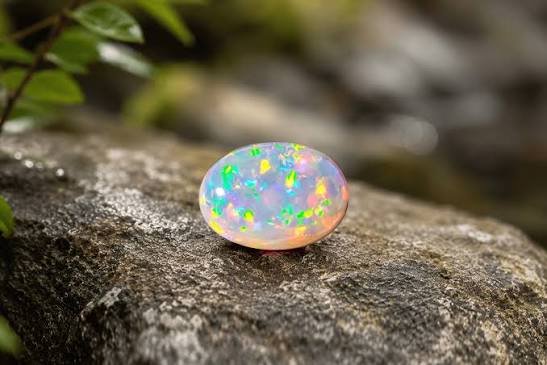
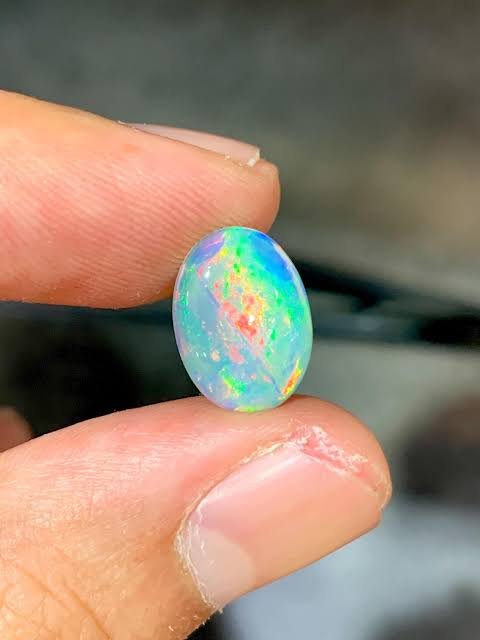
Opal is one of the most visually distinctive gemstones in the world. Unlike gems whose beauty is usually defined by a single dominant color, an Opal gemstone can appear to change as it moves, revealing flashes of green, blue, orange, yellow, red, violet and other spectral colors.
This captivating phenomenon, known as play-of-color, is one of the reasons Opal has remained a favorite among jewellery lovers, collectors and gemstone enthusiasts.
But buying an Opal stone involves more than simply choosing the most colorful piece. Type, body tone, pattern, brightness, transparency, construction, treatments, origin and natural-versus-laboratory-created status can all influence appearance, durability and value.
Whether you are considering an Opal ring, pendant, earrings or a loose gemstone, understanding these factors can help you make a more informed purchase.
Important product note: The Opal shown with this article is discussed separately in the product-description section. Its exact origin, carat weight, dimensions, treatment status, quality grade, laboratory identification and authenticity cannot be established from the photograph alone and should be confirmed through the seller’s product documentation where applicable.
What Is an Opal Gemstone?
Opal is a hydrated form of silica, commonly represented by the formula SiO₂·nH₂O. Unlike many traditional gemstones, Opal does not have the same crystalline structure as minerals such as sapphire or ruby. Its internal structure and composition are responsible for many of its distinctive optical characteristics. GIA lists Opal’s typical Mohs hardness at approximately 5 to 6.5.
The most famous type is precious Opal, which displays play-of-color. Common Opal, sometimes called potch Opal, generally does not display this optical phenomenon.
Why Is Opal So Unique?
The defining attraction of precious Opal is its ability to produce changing flashes of color. These colors are not simply surface paint or conventional body color. They result from the interaction of light with microscopic silica structures inside the gemstone.
A simple way to imagine it is to picture countless tiny spheres arranged in an orderly structure. When light enters the stone, it interacts with this structure and is diffracted into different wavelengths of visible light. The result is the rainbow-like play-of-color associated with precious Opal.
This also explains why two Opals can look completely different—even when they come from the same mining region.
Opal History and Origins
Opal has a long history of fascination and symbolism. Its changing colors have inspired stories, folklore and artistic traditions in different parts of the world.
Australia is particularly important in the modern history of Opal. Australian deposits became commercially significant during the late nineteenth century, and Australia subsequently became the world’s dominant source of Opal. Important Australian fields include Lightning Ridge and White Cliffs in New South Wales, Coober Pedy and Andamooka in South Australia, and several Queensland fields.
Today, important Opal-producing regions include:
- Australia
- Ethiopia
- Mexico
- Brazil
- Honduras
- United States
- Other deposits around the world
GIA identifies Australia, Ethiopia, Mexico and Brazil among notable sources, with Ethiopia becoming an especially important producer of precious Opal in the modern market.
Does Origin Matter?
Yes—but origin should not be treated as a substitute for evaluating the gemstone itself.
Origin can influence geological characteristics, typical body tone, appearance, structure and market perception. For example, Australian Opal and Ethiopian Opal can exhibit distinctly different visual and structural characteristics.
However, a gemstone’s origin alone does not automatically make it superior. The individual stone’s play-of-color, pattern, brightness, construction, condition and treatment status remain important.
For a particular Opal, origin should be claimed only when it has been reliably established through appropriate documentation or laboratory examination.
Types of Opal
Opals are available in many appearances and constructions. Some classifications overlap, so a single gemstone may be described using more than one term.
| Type | Typical Appearance | Key Characteristic |
|---|---|---|
| White Opal | White to light body tone | Play-of-color appears against a light background |
| Black Opal | Dark or black body tone | Dark background can provide strong contrast for color |
| Boulder Opal | Opal associated with host rock | Natural ironstone or matrix may remain part of the gem |
| Crystal Opal | Transparent to translucent | Color can appear to float within a clearer body |
| Fire Opal | Yellow, orange or red body color | May or may not display play-of-color |
| Ethiopian Opal | Various body tones and appearances | Known for a broad range of visual characteristics |
| Common Opal | Many colors | Generally lacks play-of-color |
GIA describes white/light, black, fire, boulder and crystal/water Opal as major varieties, while noting that Opal classification can involve several overlapping categories.
White Opal
White Opal has a white or light-gray body tone. Its colorful flashes can appear softer against the pale background, although fine examples can display striking color.
Black Opal
Black Opal has a dark body tone that can create dramatic contrast with play-of-color. High-quality black Opals can command significant prices, but “black” does not automatically mean “valuable.” The individual color display and overall quality still matter.
Boulder Opal
Boulder Opal contains portions of its natural host rock, commonly ironstone. The matrix can become an integral part of the finished gemstone and contribute to its character.
Crystal Opal
Crystal Opal is transparent to semitransparent, allowing light to penetrate the stone. Play-of-color can appear to sit within the gemstone, creating a glowing effect.
Fire Opal
Fire Opal is generally associated with transparent to translucent yellow, orange or red body color and is particularly associated with Mexico. Not every Fire Opal shows play-of-color; some are prized primarily for their vivid body color.
Ethiopian Opal
Ethiopian Opal has become an important category in the international Opal market. Ethiopian material can display impressive play-of-color and occurs in different visual and structural forms.
It should not, however, be assumed that every Ethiopian Opal has the same durability or treatment history. Individual stones need to be evaluated on their own characteristics.
Common Opal
Common Opal does not normally show the characteristic play-of-color of precious Opal. It can still be attractive and may occur in a wide variety of colors and patterns.
Opal Colors and Play-of-Color
The expression play-of-color describes the flashes of spectral color that appear as a precious Opal is moved or viewed under changing illumination.
You may see:
- Red
- Orange
- Yellow
- Green
- Blue
- Violet
- Combinations of several colors
The internal silica structure determines which wavelengths of light are diffracted and therefore which colors become visible. GIA notes that the size and arrangement of microscopic silica structures influence the resulting colors.
Why Is Red Often Considered Special?
Red is often regarded as one of the more desirable play-of-color hues because strong red flashes can be relatively uncommon. However, value cannot be determined by color alone.
A bright blue-green Opal with an exceptional pattern may be more desirable to a particular buyer than a stone with limited red. Personal preference, pattern, brightness, body tone and overall appearance all matter.
Common Opal Patterns
Opal can display distinctive patterns including:
- Pinfire: small, pinpoint flashes
- Harlequin or mosaic: larger angular patches
- Flame: sweeping or flame-like color movement
- Peacock: predominantly blue and green coloration
These terms help describe appearance but should not be treated as universal grading categories.
What Determines Opal Quality and Value?
There is no single “Opal quality” measurement that applies equally to every type.
Important considerations include:
1. Play-of-Color
How attractive, vivid and extensive is the color display?
2. Body Tone
A dark body tone may create stronger contrast, while a light body tone can produce a softer appearance.
3. Color Intensity
Bright, saturated color generally attracts more attention than weak or washed-out flashes.
4. Pattern
Distinctive, well-defined patterns can increase desirability.
5. Brightness
Brightness refers to how strongly the colors appear to flash. A stone can contain many colors but still have relatively low visual brightness.
6. Transparency
Depending on the variety, transparency can influence the character and desirability of the gemstone.
7. Surface Quality
Scratches, cracks, crazing or other damage can affect appearance and durability.
8. Size and Shape
Larger, attractive stones can be more difficult to source, but size alone does not guarantee high value.
9. Origin
Origin can affect market perception and characteristics, but it should be properly documented rather than assumed.
10. Natural, Treated or Laboratory-Created Material
Disclosure is essential. Natural Opal, treated Opal and synthetic/laboratory-created material should not be represented as interchangeable.
GIA identifies play-of-color, intensity and pattern as important Opal value factors and also considers color, clarity, cut and carat weight in evaluating the gem.
How Much Does Opal Cost?
There is no meaningful single fixed Opal gemstone price.
Two stones of the same weight can have dramatically different values because of differences in type, body tone, color, brightness, pattern, transparency, condition, origin, construction and treatment.
When comparing prices, consider:
- Type of Opal
- Natural versus laboratory-created material
- Solid Opal versus doublet/triplet
- Play-of-color
- Color intensity
- Pattern
- Body tone
- Size
- Surface condition
- Origin, where verified
- Treatment
- Documentation and certification
High-quality natural Opal can command substantial prices, while commercial-quality material can be much more accessible.
For this reason, unusually low or unusually high prices should encourage a buyer to ask questions rather than assume that price alone proves quality.
A trustworthy seller should provide clear product information instead of relying on a generic “Opal price per carat.”
Natural Opal vs Synthetic or Lab-Created Opal
A natural Opal forms through geological processes. Laboratory-created or synthetic Opal is manufactured by people under controlled conditions.
Synthetic gemstones can reproduce certain optical characteristics of their natural counterparts, but their manufacturing history is different. GIA distinguishes natural, laboratory-grown and imitation materials as separate categories.
For buyers, the important point is simple:
Know what you are purchasing.
A seller should clearly disclose whether the material is:
- Natural
- Laboratory-grown/synthetic
- An imitation
- Treated
- Composite
- A doublet
- A triplet
Appearance alone is not always enough to establish identity or treatment. For higher-value purchases, independent gemological testing may be appropriate.
Opal Treatments and Enhancements
Opal may undergo treatments designed to alter appearance, color, apparent clarity or durability.
Potential treatments or constructions include:
Stabilization
A porous or fragile material may be impregnated with another substance to improve apparent stability.
Dyeing
Color can be introduced or intensified through dyeing. Disclosure is important because treated material should not be confused with naturally colored material.
Smoke Treatment
Some Opals, particularly certain porous materials, can be treated using smoke or related processes to alter their appearance.
Resin or Polymer Treatment
Resin, plastic or other materials may be introduced into Opal to modify appearance or durability. GIA notes that Opals may be treated through impregnation with oil, wax or plastic and through surface modifications.
Doublets and Triplets
A doublet consists of a layer of Opal attached to another material, often a darker backing.
A triplet generally contains an Opal layer plus a backing and a protective transparent top layer.
Doublets and triplets can offer an attractive appearance at different price points, but their construction affects care requirements and should always be disclosed.
How to Identify a Genuine Opal
Searching for “how to identify real Opal” is common, but there is an important limitation: no simple home test can guarantee authenticity, natural origin and treatment status in every case.
Instead, use a combination of practical checks.
Look for:
- A credible seller
- Clear natural/synthetic disclosure
- Solid/doublet/triplet disclosure
- Treatment information
- Consistent product photography
- Accurate dimensions and weight
- Return policy
- Appropriate certification for higher-value stones
- Laboratory identification when warranted
Visual inspection can provide clues, but it cannot reliably establish every aspect of a gemstone’s identity.
For valuable purchases, a qualified gemological laboratory can provide substantially stronger evidence. GIA, for example, states that its Colored Stone Identification Report can assess characteristics such as weight, measurements, shape, cutting style and color, and identify whether material is natural or laboratory-grown and whether detectable treatments are present.
Opal Meaning and Symbolism
Opal has inspired symbolism for centuries.
Traditionally, Opal is associated with qualities such as:
- Creativity
- Inspiration
- Hope
- Emotional expression
- Individuality
- Imagination
- Personal transformation
These associations belong to cultural, historical and spiritual traditions. They are not scientifically proven medical effects.
For many people, the appeal of Opal is simply that its constantly changing colors beautifully represent individuality and self-expression.
Opal Astrology: Opal and Venus/Shukra
In Vedic astrology, Opal is traditionally associated with Venus, or Shukra. Venus is traditionally connected with themes such as beauty, luxury, artistic expression, relationships and refinement.
According to traditional astrological practices, Opal may be recommended for certain individuals based on their birth chart and planetary considerations.
Some traditional practitioners recommend wearing Opal in a precious-metal setting, commonly associated with silver, white gold or other suitable metals, and prescribe particular days, fingers and rituals according to the individual’s astrological system.
However, these practices vary considerably among astrologers.
Astrological benefits are matters of belief and tradition and are not scientifically established. Opal should not be presented as a treatment for medical conditions or as a scientifically proven method of changing health, wealth or life outcomes.
Anyone purchasing Opal for astrological reasons should therefore distinguish traditional guidance from gemological facts.
Opal Benefits: What Can You Reasonably Expect?
When people search for Opal benefits or Opal stone benefits, they may be referring to both symbolic traditions and practical jewellery benefits.
Traditional or Spiritual Associations
Opal is traditionally associated with:
- Creativity
- Inspiration
- Emotional expression
- Individuality
- Hope
- Self-expression
These are symbolic beliefs, not established medical effects.
Aesthetic Benefits
From a jewellery perspective, Opal offers genuine visual advantages:
- Every stone can have an individual appearance
- Play-of-color creates movement
- It complements both contemporary and traditional designs
- Different body tones suit different jewellery styles
- It can be paired with diamonds and other gemstones
- It offers a distinctive alternative to conventional transparent colored stones
Opal Jewellery
Opal works beautifully in a range of jewellery designs.
Opal Rings
Opal rings can be striking statement pieces. Because Opal is relatively softer than many commonly used jewellery stones, protective settings and thoughtful wear are particularly important.
Opal Pendants
Pendants can be a practical way to enjoy Opal because the gemstone is generally less exposed to repeated impact than a ring stone.
Opal Earrings
Earrings allow designers to showcase matching or complementary Opals while keeping the stones away from many everyday impacts.
Opal Bracelets
Bracelets can be beautiful but require care because they can encounter knocks against desks, doors and other hard surfaces.
Custom Opal Jewellery
Custom jewellery can be designed around the individual shape, pattern and color of a particular Opal. This is especially attractive for unusual cabochons or stones with distinctive natural patterns.
How to Care for Opal
Opal deserves gentle care.
Avoid Harsh Chemicals
Perfume, household chemicals, cleaning solutions and other substances can potentially affect certain Opals or treatments.
Avoid Excessive Heat
Rapid or excessive drying can be harmful to some Opals. GIA notes that heat, excessive dryness, bright light and direct sunlight can contribute to crazing in susceptible material.
Avoid Sudden Temperature Changes
Do not deliberately expose an Opal to extreme temperature changes.
Clean Gently
A soft cloth and mild soapy water are generally appropriate for suitable Opal jewellery. GIA specifically identifies warm soapy water as safe for Opal care.
Be Cautious With Ultrasonic and Steam Cleaners
Do not assume that every Opal construction is suitable for ultrasonic or steam cleaning. When the stone’s construction or treatment is unknown, gentle manual cleaning is the safer approach.
Special Care for Doublets and Triplets
Doublets and triplets may have layers or adhesives that require more careful handling. Prolonged exposure to moisture, heat or inappropriate cleaning methods can be particularly undesirable.
How to Store Opal
Proper storage can help preserve an Opal’s surface and reduce the chance of accidental damage.
- Store Opal separately from harder gemstones.
- Use a soft jewellery pouch or lined compartment.
- Avoid letting stones rub against one another.
- Keep jewellery away from unnecessary heat.
- Avoid prolonged direct sunlight or hot storage environments.
- Protect the gemstone from impact.
- When travelling, place individual pieces in separate soft compartments.
Opal has a Mohs hardness of roughly 5 to 6.5, so harder materials can scratch it.
How to Buy the Right Opal: A Practical Checklist
Before purchasing an Opal gemstone, ask:
1. Is it Natural or Synthetic?
Do not assume that an attractive appearance means natural origin.
2. Is It Solid, a Doublet or a Triplet?
Construction can affect value, appearance and care requirements.
3. Has It Been Treated?
Ask for treatment disclosure.
4. What Is the Origin?
If origin is important to you, ask whether it is documented or laboratory-established.
5. How Strong Is the Play-of-Color?
Look at the stone under different lighting and angles when possible.
6. What Colors Are Present?
Consider whether you prefer red, orange, green, blue, violet or a balanced combination.
7. Is the Pattern Attractive?
Look beyond the number of colors. Pattern and distribution matter.
8. Is the Surface Clean?
Check for cracks, crazing, chips or other visible damage.
9. Is Certification Appropriate?
For higher-value stones, consider independent laboratory documentation.
10. Who Is the Seller?
Seller reputation matters enormously when buying gemstones online.
11. What Is the Return Policy?
A transparent return policy gives buyers additional confidence.
12. Have You Compared Like With Like?
Do not compare a natural solid Black Opal directly with a treated triplet and assume the cheaper one is a bargain.
Why Choose Our Opal?
Choosing an Opal should be about more than buying a beautiful photograph.
A quality-focused gemstone seller should aim to make the purchasing process as transparent as the gemstone itself.
When selecting an Opal from our collection, look for product information covering the characteristics that genuinely matter—such as the stone’s visible appearance, dimensions, weight where provided, construction, treatment disclosure and any available documentation.
Our approach should always be based on:
- Product transparency
- Quality-conscious sourcing
- Accurate product information
- Clear disclosure
- Responsible presentation
- Secure packaging
- Responsive customer support
We do not recommend making assumptions about an Opal’s origin, treatment, certification, carat weight or laboratory status from an image alone. Where specific documentation is available, those details should be confirmed from the individual product listing or accompanying report.
That distinction matters because trustworthy gemstone buying begins with accurate information.
Product Description: Opal Shown in the Image
Oval Opal Gemstone with Multicoloured Play-of-Color
The Opal shown in the accompanying image presents an oval-shaped polished appearance with visible multicoloured play-of-color. Its surface displays changing flashes of color that give the gemstone the lively, dynamic character associated with precious Opal.
The oval form gives the stone a classic jewellery-friendly silhouette, making this style suitable for designs such as rings, pendants or custom settings, depending on its actual dimensions and construction.
Product-specific specifications—including exact carat weight, measurements, origin, treatment, grade, natural status and laboratory certification—should be confirmed from the product documentation rather than inferred from the photograph.
Frequently Asked Questions About Opal
1. What is Opal?
Opal is a hydrated silica gemstone known for its wide range of colors. Precious Opal is distinguished by its characteristic play-of-color, while common Opal generally lacks this phenomenon.
2. Is Opal a precious gemstone?
Precious Opal is traditionally classified among the world’s important precious gemstones because of its exceptional play-of-color. However, not every Opal is precious Opal; common Opal does not normally display play-of-color.
3. What is play-of-color?
Play-of-color is the optical phenomenon that causes flashes of spectral colors to appear as a precious Opal is moved or viewed under changing light. It results from diffraction associated with Opal’s microscopic internal structure.
4. Which Opal is the most valuable?
There is no single universal answer. High-quality Black Opal is often associated with significant values because a dark body tone can provide strong contrast, but brightness, pattern, color, condition, size and other factors must also be considered.
5. Is Opal suitable for everyday wear?
Opal can be worn in jewellery, but it requires more care than harder gemstones. Rings receive particularly high exposure to knocks and scratches, so protective settings and sensible wear habits are recommended.
6. How should Opal be cleaned?
Use a soft cloth and gentle soapy water when appropriate. Avoid harsh chemicals and do not use ultrasonic or steam cleaning unless the stone’s specific construction is known to be suitable.
7. Can Opal be worn in a ring?
Yes. Opal is frequently used in rings, but ring settings should provide appropriate protection because Opal is comparatively soft and can be vulnerable to impact and scratching.
8. Is Ethiopian Opal different from Australian Opal?
Yes. They can differ in geological characteristics, body appearance, internal structure and typical market characteristics. Origin alone does not determine the quality of an individual stone.
9. How can I tell if an Opal is genuine?
Visual inspection can provide clues but cannot guarantee natural origin, treatment status or authenticity in every situation. For valuable purchases, buy from a reputable seller and consider appropriate gemological documentation.
10. Does Opal have astrological significance?
Yes. In Vedic astrology, Opal is traditionally associated with Venus or Shukra. These associations belong to astrological tradition and are not scientifically established.
11. What is the difference between solid Opal, doublet and triplet?
A solid Opal is a complete piece of Opal material. A doublet combines an Opal layer with a backing, while a triplet generally adds a protective top layer as well. Construction should be disclosed because it affects care, appearance and value.
12. Why do Opal prices vary so much?
Opal prices vary because quality is highly individual. Type, play-of-color, brightness, pattern, body tone, size, condition, origin, treatment and construction can all affect value.
13. Is Australian Opal better than Ethiopian Opal?
Not automatically. Australian and Ethiopian Opals can have very different characteristics. The better choice depends on the individual stone and what the buyer values.
14. Is Fire Opal always colorful?
Not necessarily. Fire Opal is often recognized for its yellow, orange or red body color. Some examples display play-of-color, while others do not.
15. Can Opal crack?
Some Opals can develop cracks or “crazing,” particularly under unfavorable conditions involving heat or excessive drying. Gentle handling and appropriate storage are therefore important.
16. Should I buy Opal based only on carat weight?
No. Carat weight is only one consideration. Two Opals with identical weights can have very different values because their visual quality and construction may differ subs
