

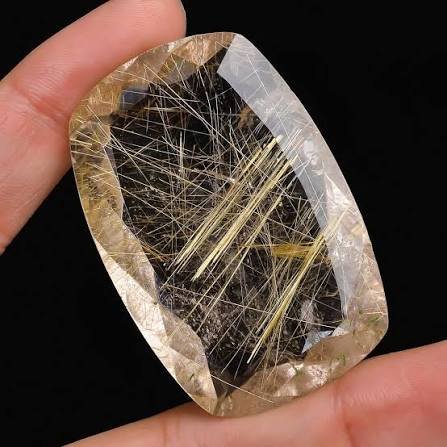
Golden Rutilated Quartz is a distinctive gemstone admired for its transparent quartz body and delicate golden threads that appear to float inside the crystal. These striking internal patterns create a beautiful contrast between clear quartz and warm, metallic-looking inclusions.
Sometimes called Golden Rutile Quartz, this gemstone is popular among jewelry lovers, crystal collectors, and people who appreciate natural mineral patterns. Each piece can have a different arrangement of golden needles, making its appearance an important part of its appeal.
Unlike gemstones valued mainly for a uniform color, Golden Rutilated Quartz stands out because of its internal character. Fine, scattered needles may create an elegant appearance, while dense golden strands can produce a dramatic, almost sunlit effect.
This guide explores its mineral properties, formation, traditional symbolism, jewelry applications, buying considerations, and care requirements.
Identification note: The gemstone pictured appears consistent with Golden Rutilated Quartz based on its visible golden, needle-like inclusions and transparent body. However, photographs alone cannot establish authenticity, confirm that the inclusions are rutile, or determine whether the stone is natural or treated.
What Is Golden Rutilated Quartz?
Golden Rutilated Quartz is a variety of quartz containing slender mineral crystals that resemble golden needles, hairs, or threads. These inclusions are commonly identified as rutile, a titanium dioxide mineral with the chemical formula TiO₂.
The surrounding quartz is silicon dioxide, with the chemical formula SiO₂. Together, these minerals create the characteristic appearance that makes this Rutilated Quartz gemstone so recognizable. Gemological literature documents rutile as a common needle-like inclusion in quartz. Source: GIA, Prismatic Rutile in Quartz.
The inclusions can occur in different arrangements, including:
- Fine, hair-like golden threads.
- Long needles crossing one another.
- Dense golden clusters.
- Sparse inclusions suspended in clear quartz.
- Fan-shaped or radiating patterns.
The word rutilated describes the presence of rutile-like inclusions. Because other minerals and materials can sometimes produce similar visual effects, professional examination may be necessary to establish their identity.
Physical Appearance of Golden Rutilated Quartz
The beauty of Golden Rutilated Quartz comes from the relationship between its transparent background and its internal golden patterns.
Color and transparency
The quartz body is often colorless or nearly transparent, although some examples may have a slight smoky, yellowish, or cloudy appearance. The internal needles can range from pale gold to rich yellow-gold, coppery gold, or brownish gold.
The contrast between the body and inclusions affects how bright and noticeable the patterns appear.
Natural-looking internal patterns
Rutile needles may appear straight, curved, scattered, clustered, or intersecting. Some stones feature delicate threads, while others display a dense network of inclusions.
These patterns are important when selecting a gemstone because they contribute to its individual visual identity.
Cut and polish
Golden Rutilated Quartz can be shaped into cabochons, beads, polished specimens, and faceted gemstones. A well-executed cut can improve light return and make the internal inclusions easier to appreciate.
The supplied product image appears to show a transparent, faceted stone with visible golden needle-like patterns. The combination of polished facets and contrasting inclusions gives it a distinctive appearance.
The exact cut style, clarity grade, and surface condition should be confirmed by examining the physical stone rather than relying on the photograph alone.
Mineral Composition and Formation
Golden Rutilated Quartz forms when quartz develops around or alongside needle-like rutile crystals during geological processes.
Quartz commonly grows in mineral-rich environments, including veins and cavities where silica-bearing fluids circulate through rock. Under suitable conditions, rutile crystals may develop within the growing quartz or become enclosed as the crystal forms.
The resulting inclusions can remain visible inside the transparent host mineral, creating the characteristic golden threads.
Rutile is primarily composed of titanium dioxide, whereas quartz consists of silicon dioxide. Their contrasting compositions and optical appearances contribute to the gemstone’s distinctive look.
Rutilated quartz is documented in several parts of the world, including Brazil, Madagascar, and other mineral-producing regions. Brazil, particularly the state of Bahia, is well known for attractive specimens. However, the appearance of an individual gemstone does not establish its geographical origin. Sources: GIA, Varieties of Rutilated Quartz; Mindat, Rutilated Quartz.
Key Gemstone Properties
Understanding the general properties of quartz helps buyers make informed decisions about Golden Rutilated Quartz.
| Property | General information |
|---|---|
| Mineral family | Quartz containing mineral inclusions |
| Chemical formula of quartz | SiO₂ |
| Typical inclusion in golden rutilated quartz | Rutile, TiO₂ |
| Mohs hardness | Approximately 7 for quartz |
| Crystal system | Trigonal |
| Luster | Vitreous, or glass-like |
| Transparency | Transparent to translucent, depending on the specimen |
| Refractive index | Approximately 1.544–1.553 for quartz |
| Cleavage | No distinct cleavage |
| Fracture | Commonly conchoidal |
These are general gemological reference values, not laboratory measurements of the pictured product. Reference data for rutilated quartz are available through Gemdat.
Hardness and durability
Quartz has a Mohs hardness of about 7, making it reasonably suitable for many jewelry applications. However, hardness measures resistance to scratching, not resistance to breaking.
A faceted gemstone can still chip or fracture if dropped or struck, especially around pointed corners, thin edges, or existing fractures.
Luster and crystal structure
Quartz typically has a glass-like luster when polished. Its trigonal crystal structure is reflected in its mineral properties, although a finished gemstone’s external shape depends on how it has been cut.
What is known about your product?
The photograph provides a visual reference for the transparent body, golden-looking inclusions, and faceted finish. Its measured hardness, refractive index, weight, dimensions, treatment status, and confirmed mineral identity have not been established from the image.
For an accurate product listing, keep general mineral properties separate from specifications verified for the individual stone.
Meaning and Symbolism of Golden Rutilated Quartz
Golden Rutilated Quartz has a strong following in crystal-collecting and spiritual communities. Its golden threads are often interpreted symbolically as rays of light, pathways, or strands connecting ideas and intentions.
In contemporary crystal traditions, it is commonly associated with:
- Clarity: Representing clearer thinking and self-understanding.
- Confidence: Symbolizing courage and belief in one’s abilities.
- Transformation: Serving as a reminder of personal development.
- Abundance: Representing opportunity, prosperity, and growth.
- Positivity: Encouraging an optimistic outlook during challenging periods.
These meanings vary among practitioners and traditions. They are symbolic interpretations rather than scientifically established properties of the mineral.
For many collectors, the gemstone’s meaning is personal: its golden inclusions may represent ambition, hope, creativity, or an important life milestone.
Popularly Claimed Benefits
Golden Rutilated Quartz is sometimes described in crystal wellness practices as a stone associated with mental clarity, motivation, and positive change.
Commonly reported claims include:
Confidence and motivation
Some practitioners use the crystal as a symbolic reminder to act decisively, pursue goals, and trust their judgment.
Focus and clarity
Its clear quartz body and fine internal patterns are sometimes associated with organizing thoughts and maintaining attention.
Positivity and personal growth
The golden color is often interpreted as a symbol of optimism, inner strength, and fresh opportunities.
Spiritual reflection
Some people keep the stone nearby during meditation, journaling, or personal reflection as a reminder of their intentions.
Important wellness disclaimer: These benefits are based on traditional beliefs and personal experiences, not reliable scientific evidence that the gemstone produces specific psychological or physical effects. Golden Rutilated Quartz is not a medical treatment and should not replace professional healthcare.
Chakra and Spiritual Associations
In contemporary crystal practices, Golden Rutilated Quartz is frequently associated with the solar plexus chakra, which symbolizes confidence, personal power, and determination in those traditions.
It may also be linked to:
- Crown chakra: Spiritual awareness and reflection.
- Solar plexus chakra: Confidence, purpose, and motivation.
- Root chakra: Grounding and stability in some interpretations.
Associations can differ between crystal practitioners, and there is no scientific evidence that gemstones activate chakras or alter the body’s energy systems.
People who enjoy these traditions may use the gemstone during meditation or intention-setting as a personal ritual.
