

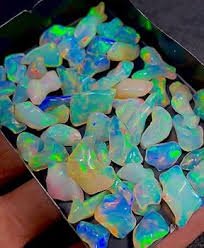
Opal rough is a fascinating natural gemstone material valued for its distinctive colours, natural textures, and potential to reveal beautiful patterns when carefully cut and polished. From gemstone cutters and jewellery manufacturers to collectors and gemstone dealers, buyers appreciate rough opal for the opportunity to discover its unique characteristics before it becomes a finished gemstone.
Unlike a polished opal, which displays its final shape and surface, natural opal rough retains its original form as it is recovered from the ground. Depending on the specimen, it may contain vibrant flashes of colour, subtle milky tones, transparent areas, attractive host rock, or combinations of these features.
One of the most remarkable qualities of precious opal is its play-of-colour, an optical effect that produces flashes of different colours as the stone or viewing angle changes. However, not every opal displays this effect. Common opal, for example, may be valued for its colour, texture, and appearance without showing distinct colour flashes.
Whether you are sourcing material for gemstone cutting, developing a jewellery collection, or expanding a mineral collection, understanding opal rough helps you make informed purchasing decisions.
2. What Is Opal Rough?
Opal rough is opal in its uncut and generally unpolished state. It may occur as irregular nodules, seams, fragments, veins, or material attached to its natural host rock.
Composition and Formation
Opal is a hydrated form of silica with the general composition SiO₂·nH₂O. Unlike crystalline gemstones such as quartz, opal does not have the same regular crystalline structure. Its water content varies, and its internal structure influences its appearance and physical behaviour.
Precious opal contains microscopic silica structures arranged in a way that can diffract visible light, creating play-of-colour. Common opal lacks the ordered structure required for this distinctive optical effect.
Rough Opal vs Polished Opal
The primary difference is the stage of processing.
- Opal rough: Uncut material that retains its natural surface and shape.
- Cut opal: Material shaped by a lapidary into a suitable form.
- Polished opal: A finished gemstone with a smooth, reflective surface.
- Opal cabochon: A gemstone shaped with a rounded, usually domed top, commonly used in jewellery.
Rough material allows buyers to assess the natural specimen and explore possible cutting options. However, its finished appearance and usable yield cannot always be predicted from the outside.
3. Types of Opal Rough
Opal rough is available in several varieties, each with different visual characteristics and potential applications.
Precious Opal Rough
Precious opal is recognised by its play-of-colour. Depending on the specimen, it may display red, orange, yellow, green, blue, or multicoloured flashes. Colour intensity, distribution, and pattern can influence its desirability.
Common Opal Rough
Common opal generally does not show pronounced play-of-colour. It may occur in white, pink, green, blue, brown, or other colours. It is used for ornamental objects, cabochons, carvings, and mineral collections, depending on its quality.
White Opal Rough
White opal typically has a light or milky body appearance. Precious varieties may display colourful flashes against a pale background, while common white opal may appear relatively uniform.
Black Opal Rough
Black opal has a dark body tone that can create strong contrast with its play-of-colour. Precious black opal can be highly desirable, but a dark-looking rough specimen should not automatically be classified as natural black opal without proper examination.
Boulder Opal Rough
Boulder opal occurs in association with ironstone or other host rock, particularly in recognised Australian deposits. The host material may remain attached to the opal and become part of the finished gemstone’s appearance.
Fire Opal Rough
Fire opal is commonly associated with yellow, orange, or reddish body colours. Some specimens are transparent to translucent, while others are more opaque. Fire opal may or may not display play-of-colour, so its body colour and optical characteristics should be assessed separately.
Important: These categories describe general opal varieties. The exact type, origin, treatment status, and classification of the product offered here should be confirmed before being stated as product-specific facts.
4. Natural Colours and Patterns of Opal Rough
Opal rough can display a broad range of natural appearances. Body colour may include white, cream, grey, brown, black, yellow, orange, red, pink, blue, or green.
The main visual features include:
- Play-of-colour: Colour flashes that change with viewing angle.
- Brightness: The apparent intensity of the colour display.
- Pattern: Colour arrangements that may appear as pinpoints, broad flashes, stripes, patches, or other distinctive formations.
- Transparency: Opal can range from transparent and translucent to opaque.
- Natural texture: The surface may be smooth, rough, fractured, earthy, or attached to host rock.
Not every rough specimen reveals its full colour potential on the surface. Cutting may expose internal colour patterns, but it can also reveal fractures, unwanted inclusions, or areas unsuitable for gemstone use.
5. Origin and Formation of Opal Rough
Opal generally forms when silica-rich water moves through rock or sediment and deposits silica as conditions change. Over time, the material develops into opal. Geological conditions, including the host material, water availability, and local chemistry, influence the resulting deposits.
Important sources of opal include:
- Australia: Known for precious black opal, white opal, and boulder opal deposits.
- Ethiopia: Known for several varieties of precious opal, including hydrophane opal that can absorb water.
- Mexico: Recognised for colourful fire opal and other opal varieties.
- Other regions: Opal deposits also occur in countries including Brazil and the United States.
These examples describe established sources of opal generally. The origin of our product has not been specified and should be confirmed before publication.
Product origin: [Product Origin]
6. Key Features and Gemological Characteristics
The following are general properties of opal, not laboratory-confirmed measurements for the specific product being offered.
| Property | General information |
|---|---|
| Mineral classification | Hydrated amorphous silica |
| Chemical composition | SiO₂·nH₂O |
| Mohs hardness | Approximately 5–6.5 |
| Lustre | Commonly vitreous to waxy |
| Transparency | Transparent to opaque |
| Optical effect | Play-of-colour in precious opal |
| Cleavage | No true cleavage |
| Toughness | Variable; can be vulnerable to impact and cracking |
| Water content | Variable by specimen and opal type |
Although opal is suitable for many jewellery applications, it generally requires more careful handling than harder gemstones such as sapphire. Its water content and internal structure can influence stability, so not all specimens respond equally to changes in temperature, humidity, or handling.
Product-specific characteristics:
- Type: [Confirmed Opal Type]
- Dimensions: [Available Sizes]
- Weight: [Weight]
- Treatment status: [Treatment Details]
- Certification: [Certification Details]
7. Quality and Grading Factors of Opal Rough
There is no single grading scale that applies uniformly to every type of rough opal. Buyers should consider the specimen’s intended use and evaluate the following factors.
Colour Play and Brightness
For precious opal, the strength, visibility, and distribution of play-of-colour are important considerations. The colours visible under one lighting condition may look different under another.
Body Tone and Pattern
Body tone influences contrast, while distinctive colour patterns may contribute to visual appeal. These characteristics should be assessed alongside the specimen’s type and overall quality.
Size and Cutting Yield
A larger piece is not necessarily more valuable. The amount of usable gem material remaining after cutting can be more important than the original weight.
Cracks, Inclusions, and Stability
Visible fractures, sand inclusions, cavities, and structural weaknesses can reduce the usable portion of a specimen. Hidden flaws may become apparent only during cutting.
Stability is particularly important because some opals are more susceptible to cracking or changes associated with moisture.
Cutting Potential
A skilled lapidary assesses the colour distribution, natural shape, internal structure, and likely finished-gem dimensions before deciding how to cut the material.
8. Uses of Opal Rough
Natural opal rough serves several purposes across the gemstone and jewellery industries.
- Gemstone cutting: Rough material can be shaped and polished into finished gemstones.
- Cabochon production: Suitable pieces may be transformed into domed stones for rings, pendants, earrings, and other jewellery.
- Jewellery manufacturing: Designers can select material according to colour, shape, and intended setting.
- Gemstone collecting: Uncut specimens offer an opportunity to appreciate natural textures, host rock, and geological features.
- Decorative applications: Suitable material may be used for small carvings, displays, and ornamental objects.
- Gemstone trading: Dealers may source rough opal for resale, cutting, or supply to jewellery manufacturers.
The most suitable use depends on the specimen’s characteristics, stability, and available cutting material.
9. Benefits of Buying Opal Rough
For Gemstone Cutters
Rough opal offers the opportunity to evaluate natural material and determine a cutting approach based on its individual features. Experienced cutters can select orientations intended to showcase colour and minimise waste.
For Jewellery Designers
Purchasing rough material can provide flexibility in developing distinctive gemstones and coordinating them with specific designs.
For Collectors
Uncut opal preserves natural surfaces and geological features that may not remain visible after polishing.
For Gemstone Dealers
Rough opal can support sourcing and supply activities for customers seeking uncut material. Clear information about origin, treatment, stability, and usable yield helps build buyer confidence.
However, cutting outcomes and resale prices are uncertain. Purchasing rough opal should be based on the material’s documented characteristics and the buyer’s intended use rather than an assumed financial return.
10. How to Select Good-Quality Opal Rough
Before purchasing opal rough, consider these practical checks:
- Examine the colour: View the specimen under suitable lighting and, for precious opal, observe whether the play-of-colour changes with angle.
- Inspect the surface: Look for visible cracks, chips, cavities, and damaged areas.
- Check for moisture-related concerns: Ask whether the material is stable, whether it is hydrophane, and whether its appearance changes when exposed to water.
- Assess cutting potential: Consider the likely finished shape, colour orientation, and usable yield.
- Ask about treatments: Confirm whether the material has undergone dyeing, impregnation, smoking, sugar-acid treatment, or other processing where relevant.
- Request clear photographs and videos: Ask for multiple angles and neutral lighting. Video can help demonstrate colour changes with viewing angle.
- Verify product details: Request available weight, dimensions, origin information, and any supporting identification documents.
- Seek expert inspection: A gemologist or experienced lapidary may help identify the opal variety, assess stability, and evaluate cutting risks.
Avoid relying on a single surface photograph or attempting destructive tests on valuable material.
11. Care and Storage of Opal Rough
Opal care depends on the variety, stability, treatment status, and water sensitivity of the specimen.
- Handle rough opal carefully to avoid accidental impacts.
- Store specimens separately from harder gemstones that may scratch them.
- Keep them in a stable environment and avoid sudden temperature changes.
- Do not assume that soaking is safe; hydrophane opal and treated material may react differently to water.
- Avoid harsh chemicals, ultrasonic cleaners, and steam cleaning unless a qualified professional confirms that a particular specimen can tolerate the method.
- For routine surface cleaning, use a soft, dry cloth or a gentle method appropriate to the confirmed material.
For unknown or potentially unstable opal, consult a gemstone professional before using water or applying any cleaning treatment.
12. Natural Opal vs Synthetic and Imitation Opal
Natural opal forms through geological processes. Synthetic opal is manufactured to reproduce some of the structural and optical features of natural opal. Imitation opal may use glass, resin, plastic, or other materials to resemble genuine opal.
Distinguishing them can require professional examination. A qualified gemologist may use magnification, microscopy, observation of colour patterns, and other appropriate tests to assess the material.
Some assembled products, including doublets and triplets, combine opal with other materials. These are different from solid opal and should be accurately disclosed when sold.
Visual inspection alone may not establish whether a specimen is natural, synthetic, treated, or assembled. Certification or a gemological report can provide additional confidence when available.
13. Factors Affecting Opal Rough Price
The price of rough opal varies according to the individual specimen and the market in which it is sold.
Key factors include:
- Type: Precious, common, fire, black, white, and boulder opals differ in appearance and market demand.
- Colour play: Brightness, colour range, pattern, and visibility can influence desirability.
- Size and weight: Larger specimens may offer more cutting material, but usable yield matters.
- Body tone and transparency: These features influence the stone’s visual character and intended applications.
- Condition and stability: Cracks and structural weaknesses may reduce cutting potential.
- Origin: Verified provenance may affect market interest, depending on the variety.
- Treatments and disclosure: Processing can influence appearance, suitability, and commercial value.
- Demand and cutting potential: Buyer preferences, availability, and the likely quality of the finished gemstone all play a role.
For an accurate quotation, buyers should assess the actual specimen rather than rely on a general price estimate.
Product price: [Price]
14. Why Choose Our Opal Rough?
Our natural rough opal offering is intended to help gemstone enthusiasts, jewellery professionals, cutters, and traders explore uncut opal material for their specific requirements.
We encourage customers to evaluate each specimen based on its visible characteristics, intended application, and suitability for further processing.
Product details
- Product name: Opal Rough
- Confirmed variety: [Confirmed Opal Type]
- Origin: [Product Origin]
- Available sizes: [Available Sizes]
- Weight range: [Weight]
- Colour and pattern: [Verified Colour and Pattern Details]
- Treatment status: [Treatment Details]
- Certification: [Certification Details]
- Price: [Price]
- Minimum order quantity: [Minimum Order Quantity]
- Packaging and shipping: [Shipping Details]
Customers may request current photographs, videos, measurements, and other available product information before placing an order.
Our goal is to provide clear product descriptions and help buyers determine whether the material meets their cutting, jewellery-making, collecting, or trading requirements. Product-specific claims should be supported by inspection or documentation wherever applicable.
15. Frequently Asked Questions About Opal Rough
1. What is opal rough used for?
Opal rough is used for gemstone cutting, cabochon production, jewellery manufacturing, collecting, and decorative applications. Its suitability depends on the material’s quality and stability.
2. How can I identify good-quality rough opal?
Examine its colour, brightness, body tone, surface condition, cracks, and potential cutting yield. For precious opal, assess the play-of-colour under different viewing angles.
3. Does all natural opal rough show play-of-colour?
No. Precious opal displays play-of-colour, while common opal generally does not. Some fire opal varieties also lack this effect.
4. What determines the price of rough opal?
Price depends on the opal variety, colour characteristics, size, usable yield, stability, condition, origin, treatment status, and market demand.
5. Can opal rough be cut and polished?
Yes, suitable material can be cut and polished by a skilled lapidary. However, fractures, internal structure, and cutting losses may affect the final result.
6. Is opal rough suitable for jewellery?
Some opal rough can be fashioned into jewellery gemstones. The finished stone’s stability, setting, intended use, and care requirements should be considered before manufacture.
7. How do I care for natural rough opal?
Handle it gently, avoid impact and sudden temperature changes, and store it separately from harder stones. Cleaning methods should be selected according to the specimen’s type and treatment status.
8. How can I tell natural opal from synthetic or imitation opal?
Professional examination can help distinguish natural opal from synthetic material and imitations. Magnification, structural observations, and appropriate gemological tests may be required.
9. Does opal rough have a confirmed country of origin?
The origin varies by deposit and supplier. The country of origin for a specific product should be confirmed through reliable supplier records or appropriate documentation rather than assumed from its appearance.
10. Can I request photographs and a quotation before buying?
Yes. Contact us to request available photographs, videos, dimensions, weight, confirmed product details, and a quotation for the relevant material.
16. Conclusion: Explore Natural Opal Rough for Your Next Project
Opal rough offers a distinctive combination of natural beauty, geological interest, and creative potential. Its colours, patterns, textures, and cutting possibilities make it relevant to gemstone cutters, jewellery manufacturers, collectors, and gemstone traders.
Understanding opal varieties, colour play, stability, cutting yield, and care requirements can help buyers make informed decisions. Since every specimen is different, evaluating the actual material and confirming its product-specific details are essential steps before purchase.
Interested in our Opal Rough?
Contact us to enquire about current availability, [Available Sizes], [Weight], [Product Origin], photographs, videos, treatment information, certification details, and pricing.
Whether you are sourcing material for jewellery production, gemstone cutting, collecting, or wholesale supply, we welcome your enquiry and look forward to helping you explore the available options.
Call to Action: Contact us today for product details and a quotation for Opal Rough.
SEO Publishing Recommendations
Suggested Internal Links
Link relevant phrases in this article to existing pages on your website:
- Natural Gemstones → [Natural Gemstones Category URL]
- Opal Gemstones → [Opal Collection URL]
- Gemstone Cutting Services → [Gemstone Cutting Services URL]
- Wholesale Gemstones → [Wholesale Gemstones Page URL]
- Contact Us → [Contact Page URL]
- Gemstone Care Guide → [Gemstone Care Article URL]
Only use links to pages that exist and are relevant to the linked text.
Suggested Image Alt Text
Use descriptive alt text that accurately represents each actual image:
Natural opal rough gemstone showing its uncut surfaceClose-up of precious opal rough displaying natural play-of-colourWhite opal rough gemstone before cutting and polishingBlack opal rough specimen with visible colour flashesBoulder opal rough showing opal and natural host rockGemstone cutter examining rough opal for cutting potentialNatural rough opal specimens arranged for gemstone selection
Adjust each description to match the image. Do not label an image as black opal, boulder opal, or another specific variety unless that identification is supported.
Final SEO Checklist
- Use one clear H1 heading containing the primary keyword.
- Keep the SEO title concise and relevant to the search intent.
- Place the primary keyword naturally in the introduction, a relevant heading, the body, and the conclusion.
- Add descriptive image alt text and compress images for faster page loading.
- Use internal links to relevant product and educational pages.
- Add structured data only when it accurately represents the page and the applicable schema requirements.
- Confirm all product-specific placeholders before publishing.
- Avoid claiming a country of origin, certification, treatment status, or quality grade without supporting evidence.
