

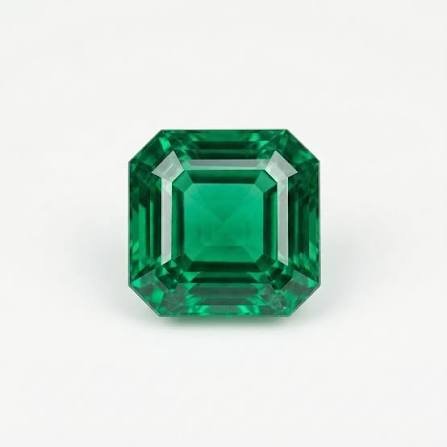
A captivating green gemstone can bring depth, sophistication, and individuality to a piece of fine jewelry. With its rich emerald-green appearance, clean square outline, clipped corners, and geometric step-cut facets, this lab-grown green gemstone offers a distinctive look that balances contemporary design with vintage-inspired elegance.
Whether you are exploring colored gemstones for a bespoke ring, a statement pendant, or a meaningful jewelry gift, this stone is an opportunity to discover the appeal of a carefully faceted green gem.
Its square silhouette and architectural facet pattern create a refined visual effect, while its saturated green appearance gives it a bold yet timeless character. The exact gemstone species and cut designation should be confirmed before purchase, but its visible design makes it an intriguing choice for jewelry lovers who appreciate symmetry, color, and understated luxury.
In this guide, we explore what lab-grown gemstones are, how to evaluate a green gemstone, what makes a square step-cut design distinctive, and what you should know before choosing one for your collection.
Product Overview: A Green Gemstone with Geometric Appeal
The product’s visual identity is defined by three prominent characteristics.
Rich green color: The gemstone displays a deep green appearance that creates a sense of richness and sophistication. Its exact color grade, hue, saturation, and consistency require formal assessment, as lighting and photography can influence how green gemstones appear.
Square shape with clipped corners: Rather than a conventional square with sharp corners, the outline appears to have its corners trimmed. This creates a balanced geometric silhouette that can complement both modern and traditional jewelry.
Step-cut appearance: The visible facet arrangement appears geometric, with broad, orderly facets rather than the numerous triangular facets typically associated with a brilliant cut. This style can emphasize symmetry, transparency, and depth.
Together, these features make the stone visually suitable for minimalist settings, architectural jewelry, vintage-inspired designs, and bold contemporary pieces.
Product specifications
| Specification | Available information |
|---|---|
| Product name | Lab-Grown Green Gemstone — provisional descriptive name |
| Gemstone species | Requires confirmation |
| Mineral composition | Requires confirmation |
| Origin | Described as lab-grown; documentation required |
| Color | Rich green appearance; formal grade unconfirmed |
| Shape | Square with clipped corners, based on visual appearance |
| Cutting style | Appears to be a step cut |
| Exact cut name | Asscher-style appearance; not confirmed |
| Clarity and transparency | Requires confirmation |
| Carat weight | Not provided |
| Dimensions | Not provided |
| Refractive index | Depends on confirmed species |
| Mohs hardness | Depends on confirmed species |
| Specific gravity | Depends on confirmed species |
| Treatments | Requires confirmation |
| Production country | Not provided |
| Certification | Not provided |
| Price and available sizes | Contact the seller for details |
These specifications should be updated with verified information before the product page is published as a fully documented gemstone listing.
What Is a Lab-Grown Gemstone?
A lab-grown gemstone is produced in a controlled environment using techniques designed to encourage crystal growth. Depending on the gemstone species, the process may involve carefully controlled temperature, pressure, chemical solutions, or other growth conditions.
The objective is to produce gem material with the relevant chemical composition and crystal structure of its natural counterpart. However, the precise relationship between a lab-grown gemstone and a natural gemstone depends on the material being produced.
Common growth techniques include:
- Hydrothermal growth: Uses heated, pressurized solutions to grow certain crystals. This method is relevant to particular gemstone materials, including some emeralds and quartz.
- Flux growth: Uses a molten solvent, or flux, to help crystals form under controlled conditions. It is used for certain synthetic colored gemstones.
- Other species-specific methods: Different materials require different manufacturing processes. There is no single method that applies to all lab-grown gemstones.
The appropriate method for this product cannot be identified from its appearance alone.
Are lab-grown and natural gemstones the same?
A properly identified laboratory-grown gemstone may share the same essential chemical composition and crystal structure as its natural counterpart. It may also have comparable optical and physical properties.
However, laboratory-grown stones can exhibit growth features, inclusions, color zoning, or other characteristics that differ from those commonly encountered in natural stones. Some materials are easier to reproduce closely than others.
A lab-grown gemstone is also different from a simulant. A simulant imitates the appearance of another gemstone but has a different material identity. For example, green glass may resemble an emerald without being emerald.
This distinction matters because a green color alone does not establish whether a stone is emerald, green sapphire, green spinel, quartz, glass, or another material.
Is This a Lab-Grown Emerald or Another Green Gemstone?
The distinction between a lab-grown green gemstone and a lab-grown emerald is important.
An emerald is a green variety of the mineral beryl, with its characteristic color associated primarily with chromium, vanadium, or both. A laboratory-grown emerald is produced artificially but is still emerald when its material identity is confirmed.
A lab-grown green gemstone, on the other hand, is a broader description. It can refer to any suitable laboratory-grown gemstone that displays a green color, including materials other than emerald.
For instance, green sapphire is corundum, while green spinel has a different mineral composition and crystal structure from emerald. These stones have their own optical properties, durability characteristics, and market considerations.
Therefore, the product should be marketed as a lab-grown green gemstone until its identity has been verified. If a gemological report confirms that it is emerald, the product title, technical information, and relevant search terms can then be updated to include “lab-grown emerald.”
Understanding the Square Step-Cut Design
Cutting style has a significant influence on how a gemstone looks, how it interacts with light, and how it appears when set in jewelry.
What is a square step cut?
A step cut typically features broad, parallel or concentric facets arranged in a geometric pattern. Instead of maximizing the rapid flashes associated with many brilliant cuts, it creates a more structured appearance.
On a square gemstone with clipped corners, this arrangement can create a distinctive combination of straight lines, layered facets, and a balanced outline.
The design may emphasize the gemstone’s transparency and internal appearance. It can also make symmetry, facet alignment, and the quality of the cutting especially noticeable.
Is it an Asscher cut?
The stone’s square outline and clipped corners suggest an Asscher-style appearance. However, a true Asscher cut has more specific cutting proportions and facet arrangements than a square outline alone can establish.
Until the cut is confirmed, “square step-cut gemstone” or “Asscher-style green gemstone” is more accurate than definitively identifying the stone as Asscher cut.
Why choose this geometric style?
This style can complement several jewelry aesthetics:
- Modern luxury: Clean lines and symmetry pair well with contemporary metalwork.
- Vintage-inspired jewelry: The geometric outline evokes the elegance of classic, architectural designs.
- Minimalist settings: A simple bezel or four-prong setting allows the gemstone to remain the focal point.
- Statement jewelry: A larger square stone can provide a bold center for a cocktail ring or pendant.
The deep green appearance adds visual intensity, while the geometric cutting style introduces structure and refinement.
Benefits of Choosing a Lab-Grown Green Gemstone
A distinctive green aesthetic
Green gemstones offer a wide spectrum of visual character, from bright yellowish greens to deep, cool forest greens. The rich green appearance of this product may appeal to buyers seeking color without choosing a conventional colorless gemstone.
The precise shade should be evaluated in different lighting conditions and, ideally, in person or through accurate product photography.
A design suited to customization
The square outline and clipped corners can work with a variety of setting styles. Depending on its confirmed dimensions and durability, the stone may be considered for rings, pendants, earrings, or other bespoke jewelry.
Its geometry can also guide the overall design, whether the aim is a streamlined solitaire or a more elaborate arrangement of accent stones.
Potential value advantages
Laboratory-grown gemstones can sometimes offer a lower purchase price than comparable natural stones. The size of that difference depends on the gemstone species, quality, manufacturing method, market demand, and the natural stone used for comparison.
A meaningful price comparison should consider more than carat weight alone. Color, clarity, cut quality, transparency, treatments, and documentation can all influence value.
Production information can support informed buying
A clearly documented laboratory-grown origin allows customers to understand what they are purchasing. However, traceability and environmental performance should not be assumed simply because a gemstone is laboratory-grown.
Buyers who prioritize production transparency should request available information about the manufacturer, growth method, treatments, and supply chain.
Lab-Grown vs. Natural Gemstones: What Should Buyers Know?
The following comparison describes general differences. Exact characteristics vary by gemstone species and individual stone.
| Factor | Lab-grown gemstone | Natural gemstone |
|---|---|---|
| Origin | Produced in a controlled environment | Forms through geological processes |
| Formation | Grows using a species-appropriate manufacturing process | Develops through natural geological conditions |
| Chemical and physical properties | May closely match the corresponding natural material | Depends on the confirmed species and individual stone |
| Appearance | Can offer attractive color and well-defined faceting | Varies with geological formation, quality, and cutting |
| Price | Often lower than comparable natural material, but not always by the same margin | Influenced by quality, rarity, origin where established, and demand |
| Availability | Depends on production capability, material, and size | Depends on supply, mining, and market availability |
| Resale considerations | Often subject to different demand and resale expectations from natural stones | Depends on species, quality, rarity, documentation, and resale market |
| Identification | May require gemological testing to confirm identity and growth origin | May require gemological testing to confirm identity and natural origin |
| Documentation | Can document identity, growth origin, and detectable treatments | Can document identity, natural origin, and detectable treatments |
Neither category is automatically superior in every respect. The best choice depends on your priorities, budget, design preferences, and expectations for future resale.
Laboratory reports can help distinguish gemstone identity and origin, but the exact services available depend on the material and laboratory.
How to Choose the Right Green Gemstone
Before purchasing a lab-grown green gemstone, consider the following factors.
1. Evaluate the color
Look for a shade of green that suits your taste and intended jewelry design. Consider whether you prefer a deep, saturated appearance or a lighter, brighter tone.
Ask whether product photographs were taken under neutral lighting and whether additional images or videos are available. This can help you judge the color more accurately.
2. Inspect cut quality
For a square step-cut gemstone, check that the outline appears balanced, the corners are evenly clipped, and the facets are aligned.
Ask for a face-up photograph and, where possible, a side view. These can reveal proportions, depth, and the relationship between the table, crown, and pavilion.
3. Ask about clarity and transparency
Clarity describes internal features and surface characteristics, while transparency describes how readily light passes through the material.
Do not assume that every laboratory-grown gemstone is flawless. Ask for the seller’s clarity description and whether inclusions or other visible features can be seen without magnification.
4. Compare carat weight with dimensions
Carat measures weight, not physical size. Two gemstones of the same carat weight can have different face-up dimensions because their densities and cutting proportions differ.
For jewelry planning, request the length, width, and depth in millimeters, along with the carat weight. A jeweler can use these measurements to assess the stone’s fit in a proposed setting.
5. Match the gemstone to the jewelry design
White gold and platinum can create a crisp contrast with green, while yellow gold can emphasize warmth and richness. Rose gold offers another distinctive color combination.
The best setting also depends on the gemstone’s durability and the wearer’s lifestyle. A protective bezel or carefully designed prong setting may be appropriate, depending on the confirmed species, cut, and dimensions.
6. Confirm identity, treatments, and seller policies
Before paying, ask for written confirmation of the gemstone species, laboratory-grown origin, treatments, measurements, and return policy.
For a valuable purchase, consider an independent gemological report from a reputable laboratory. A report may describe the gemstone’s identity, whether it is natural or laboratory-grown, detectable treatments, weight, measurements, color, shape, and cutting style.
Care and Maintenance for Your Gemstone
The correct care routine depends on the gemstone’s identity, any treatments, and the jewelry setting.
Until these details are confirmed, use a cautious approach:
- Clean gently. Use a soft cloth and avoid aggressive scrubbing. Mild, lukewarm soapy water may be suitable for many gemstones, but confirm that it is appropriate for this material and any treatments.
- Avoid unverified cleaning methods. Do not use ultrasonic cleaners, steam cleaners, harsh chemicals, or abrasive products until a jeweler confirms they are safe for the specific stone and setting.
- Protect against impacts. Even a gemstone with good hardness can chip or fracture. The clipped corners and exposed edges should be protected by an appropriate setting.
- Store separately. Keep the gemstone or finished jewelry in a soft pouch or lined compartment to reduce scratches and contact with other jewelry.
- Arrange periodic inspections. If the gemstone is mounted in a ring or other frequently worn piece, have the setting checked periodically for loose prongs, wear, or damage.
If the product is confirmed as emerald, additional care may be needed because emeralds can contain fractures and may have clarity-enhancing treatments. Gentle cleaning with warm, soapy water is generally the safest approach for emeralds; ultrasonic and steam cleaning should be avoided. See the Gemological Institute of America’s emerald care guidance for further information.
Frequently Asked Questions
1. What is a lab-grown green gemstone?
It is a gemstone produced in a controlled environment that displays a green color. Its exact identity depends on the material used. It may be emerald or another green gemstone, so its species should be confirmed before purchase.
2. Is a lab-grown emerald a real emerald?
Yes. A laboratory-grown emerald is emerald when its identity as synthetic or laboratory-grown beryl with emerald characteristics is established. It is not a naturally mined emerald, and its origin should be disclosed accurately.
This product should not be called a lab-grown emerald until its species is verified.
3. How is a lab-grown gemstone different from a natural one?
The main difference is origin: laboratory-grown stones are produced through controlled manufacturing processes, while natural gemstones form through geological processes. Depending on the species, their chemical composition, crystal structure, and physical properties may be similar, but their growth features and market values can differ.
4. Is this gemstone suitable for everyday jewelry?
That cannot be determined confidently without confirming the gemstone species, hardness, toughness, treatments, and setting. A gemstone’s resistance to scratching is not the same as its resistance to chipping or breaking.
Ask a jeweler to assess its suitability for your intended use, especially if you plan to wear it in a daily ring.
5. What does an Asscher cut mean?
An Asscher cut is a geometric step-cut style generally associated with a square outline and clipped corners. Its specific proportions and facet arrangement distinguish it from other square step cuts. The product’s appearance suggests this style, but the exact cut requires confirmation.
6. How do I choose the right carat weight?
Start with the jewelry design and the face-up dimensions you want. Carat measures weight, so it does not translate directly into a particular visible size across different gemstone species.
Request both carat weight and millimeter measurements before choosing a setting.
7. Does a lab-grown gemstone need certification?
Certification is not necessarily required for every purchase, but independent gemological documentation can be valuable. It helps establish identity, growth origin, and detectable treatments. The report’s scope and the laboratory’s capabilities should be checked before relying on it.
8. How should I clean and store this gemstone?
Until its species and treatments are confirmed, clean it conservatively and avoid ultrasonic or steam cleaning. Store it separately in a soft-lined compartment and protect it from impacts. Ask the seller for material-specific care instructions.
9. Is this gemstone suitable for an engagement ring?
Its geometric shape and green color could make it an attractive engagement-ring center stone. Suitability depends on its confirmed material, durability, size, setting, and expected frequency of wear.
A protective setting and a realistic understanding of the gemstone’s care requirements can help you make an informed choice.
10. What should I check before buying?
Confirm the gemstone species, laboratory-grown origin, growth method if known, cut, color, clarity, carat weight, dimensions, treatments, certification, price, availability, and return policy. If origin or production transparency matters to you, request supporting documentation rather than relying on assumptions.
Find Your Perfect Green Gemstone
A richly colored green gemstone with a square, clipped-corner outline and step-cut appearance offers a compelling combination of geometry, color, and understated sophistication. Its design can inspire everything from a minimalist pendant to a distinctive ring or a custom statement-jewelry creation.
The key to choosing well is understanding both its visual appeal and its verified material characteristics. Confirmed gemstone identity, accurate measurements, transparent treatment disclosures, and appropriate care guidance allow you to appreciate the design with greater confidence.
Interested in this lab-grown green gemstone? Explore the product listing, request its verified specifications, or contact our team for current pricing, available sizes, setting recommendations, and customization options. We can help you determine whether this distinctive green gemstone is the right choice for your next jewelry design.
Choose with confidence, guided by the details that make every gemstone unique.
